
SOAP Narrative for Wilderness First Aid
When Florida’s Smallest Wilderness Hazard Has the Biggest Attitude
“When definitive care is an hour away or more, you are in the wilderness.”
When most people think about dangerous wildlife on Florida’s rivers, they picture alligators lazily sunning themselves on a log or perhaps the troop of rhesus macaques that have called the Silver River home since the 1930s. Rarely does anyone mention the creature that probably sends more Floridians to urgent care than either of those.
The humble fire ant.
If you’ve lived in the South long enough, you’ve probably stepped into a mound. What many people fail to appreciate is that fire ants are not simply aggressive insects. They are highly organized colony defenders. Scout ants lay down pheromone trails leading to food sources and perceived threats. Once enough ants decide that something does not belong, they communicate with remarkable efficiency. Every ant arriving at the scene receives exactly the same message.
Attack.
That lesson came at my expense.
🚣 A Perfect Morning on the Silver River
Last month while teaching a Wilderness First Aid class to new kayak guides an old experience of mine popped back into my memory. The memory brought me laughter and the opportunity to share a learning experience with the students. I want to take you on a memory journey on one of those Florida afternoons that guides dream about.
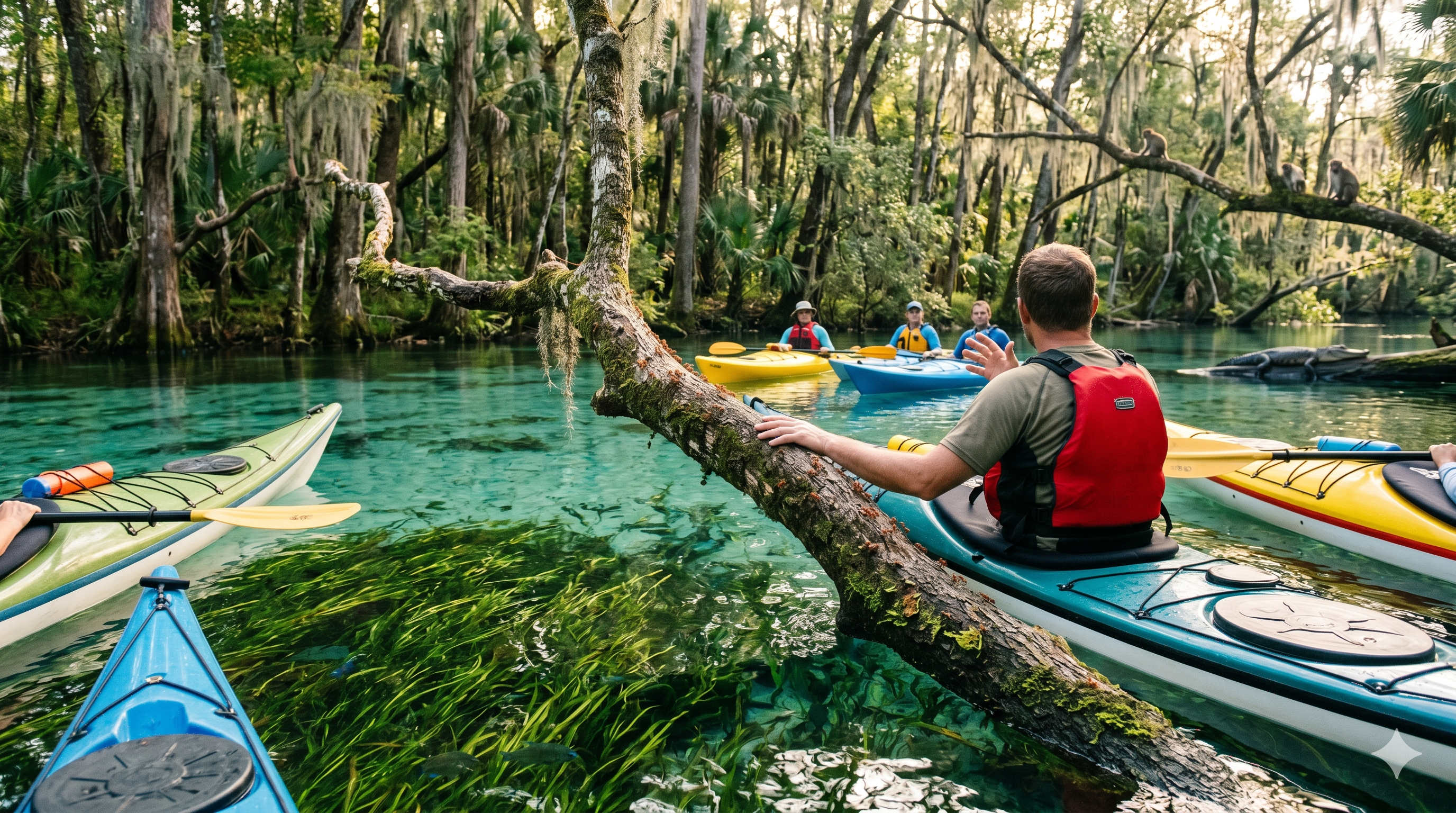
Our group launched from Ray Wayside Park near Silver Springs to paddle upstream toward the head spring. The Silver River is one of Florida’s natural treasures. The water is impossibly clear, carrying shades of blue that remind me of a polished blue topaz gemstone. Looking into the spring run is almost therapeutic. Every blade of eelgrass seems suspended in air rather than water.
Silver Springs is also one of Florida’s most storied landscapes. Long before it became a destination for paddlers, its crystal clear waters captivated filmmakers. Beginning in the 1930s, the spring run served as a backdrop for several of the original Tarzan films, where actors appeared to swing through an untouched tropical wilderness. The springs later became equally famous as a filming location for the 1954 classic Creature from the Black Lagoon, whose underwater scenes introduced generations of moviegoers to Florida’s extraordinary underwater world.
Today, paddling these same waters feels a bit like drifting through a living film set.
As always, our guests were captivated.
We watched turtles slip quietly from submerged logs.
Several alligators ignored us with the confidence that comes from living in a protected place.
Then, as if on cue, a troop of rhesus macaques appeared in the trees. Introduced during the 1930s to enhance a riverboat attraction, they have become one of the Silver River’s most unusual residents. Visitors often arrive hoping to see monkeys and leave having learned a lesson about invasive species.
Little did I know that another invasive species was preparing its own educational program.
🌳 One Thoughtless Hand Placement
We paused near the head spring to let everyone soak in the beauty of Silver Springs. While pointing out the crystal clear water, the swaying eelgrass, and a few turtles gliding effortlessly beneath our kayaks, I absentmindedly rested my right hand on a low tree branch overhanging the river.
To me it was simply a convenient place to steady myself while talking. To a colony of fire ants, however, that branch was a well traveled pheromone trail connecting one part of their world to another. The instant my hand interrupted their highway, I was no longer a guide admiring one of Florida’s most beautiful springs. I was an invading predator.
The first sting felt like a tiny pinprick. The second removed any doubt that I had made a poor decision. Looking down, I watched dozens of reddish brown ants streaming over my fingers, wrist, and the back of my hand with remarkable speed and determination. Instinctively I swept them away with my left hand, only to realize I had just recruited my other hand into the battle.
In seconds both hands were under attack. Like most paddlers, my first reaction was to plunge them into the cool, blue spring water. It felt wonderfully soothing, but the ants were far less impressed. Fire ants use their mandibles to clamp onto the skin before pivoting to sting repeatedly with their abdomen. Once anchored, they do not simply wash away. The Silver River offered water as clear as polished blue topaz, but even one of Florida’s greatest springs could not provide an instant cure for a handful of determined fire ants
🩺 Patient Assessment
Fortunately, this story ends with sore hands rather than an emergency evacuation.
After removing the remaining ants, I stopped long enough to evaluate myself just as I teach my Wilderness First Aid students.
Could I breathe normally? Yes.
Any swelling of my tongue or throat? No.
Any hoarseness? No.
Any generalized itching or hives away from the sting sites? No.
Any dizziness? No.
My symptoms remained localized to both hands.
The pain intensified over the next several minutes, followed by burning, redness, swelling, and eventually I would see the familiar sterile white pustules that commonly develop within a day after fire ant stings.
The guests were naturally concerned. I smiled and reassured them. “I’ve just been promoted from kayak guide to ant buffet.” Fortunately, the ants had only reserved one table to dine on. And it was me.
📋 SOAP Summary
S | Subjective
Patient reports multiple painful fire ant stings to both hands after placing a hand on a tree branch carrying a fire ant pheromone trail. Burning pain, localized swelling, itching, and tenderness. No previous history of anaphylaxis.
O | Objective
- Multiple fire ant stings to both hands.
- Localized redness and swelling.
- No facial swelling.
- No respiratory distress.
- No generalized hives.
- Normal speech.
- Normal mental status.
- Normal skin color.
- Able to continue guiding trip without functional impairment.
A | Assessment
Localized fire ant envenomation.
No evidence of a systemic allergic reaction or anaphylaxis.
Continued observation warranted because severe allergic reactions may develop rapidly after insect stings, even in individuals with no previous history of anaphylaxis.
P | Plan
- Remove remaining ants from the skin.
- Wash the affected areas when practical.
- Apply cold therapy to reduce pain and swelling.
- Continue monitoring for delayed allergic reactions.
- Consider an oral antihistamine if itching becomes significant and there are no contraindications.
- Maintain hydration.
- Document the incident.
- Continue guiding while frequently reassessing for new symptoms.
🚨 What If This Had Become Anaphylaxis?
My reaction remained localized.
Not every patient’s will.
Although uncommon, fire ant venom can trigger anaphylaxis, a life threatening allergic reaction that can develop within minutes, even in people who have never experienced one before.
Know the warning signs:
- Difficulty breathing.
- Wheezing.
- Swelling of the lips, tongue, or throat.
- Hoarse voice.
- Generalized hives.
- Rapidly spreading redness.
- Dizziness or fainting.
- Persistent vomiting.
- Signs of shock.
If these symptoms develop, the situation has changed from an insect sting to a true medical emergency.
Wilderness First Aid Treatment
- Stop the activity immediately.
- Activate EMS as soon as possible.
- Assist the patient with their prescribed epinephrine auto injector, if available.
- Administer epinephrine promptly according to your training and local protocols.
- Monitor airway, breathing, circulation, and mental status continuously.
- Be prepared to administer a second dose if symptoms persist, additional epinephrine is available, and your training supports it.
- Continue monitoring and prepare for evacuation to definitive medical care.
Remember, epinephrine is the first line treatment for anaphylaxis. Antihistamines may help reduce itching and hives, but they do not reverse airway swelling or shock.
🍺 The End of the Day
Loading the rental kayaks onto the company trailer proved far more uncomfortable than paddling after I got bit. Every time I tightened a strap or lifted a bow onto the rack, dozens of fire ant stings reminded me of my earlier lapse in judgment. Sean watched the expression on my face change each time I grabbed another kayak and could not help but laugh. I kept insisting, “I’m fine. They don’t bother me that much,” while my face quietly testified otherwise. By the time we returned to Clearwater that evening, both hands were swollen, tender, and decorated with an impressive collection of angry red welts and the familiar circular and semicircular pustules left behind by fire ant venom. Even the drive home was a constant reminder that creatures weighing less than a paperclip can have an outsized influence on your day.
As was our routine after every guided trip, we washed the rental kayaks, rinsed the river water and mud from the hulls, cleaned the paddles, hung the PFDs to dry, and packed away the gear before locking up for the evening. Only then did Sean reach into the cooler and hand me a well earned cold beer. I accepted it with as much dignity as a man can muster while trying to grip a bottle with two swollen hands. We laughed about the day’s adventure, realizing our guests had gone home with stories of crystal clear springs, curious rhesus macaques, ancient alligators, and one kayak guide who lost a very one sided argument with a colony of fire ants. Looking back, I suspect that was the lesson they remembered best. The wilderness has a remarkable way of turning small mistakes into unforgettable teachers, provided we are willing to laugh, learn, and tell the story well.
🎓 Teaching Points
- Fire ant stings are among the most common wilderness medical problems in the southeastern United States.
- Fire ants bite to anchor themselves before delivering multiple venomous stings.
- Water alone may not immediately remove attached ants.
- Patients without a history of anaphylaxis can still develop severe allergic reactions.
- Continue monitoring after any multiple insect sting exposure.
- Guides should always carry a well stocked first aid kit and know how to recognize anaphylaxis.
- The best patient assessment begins before symptoms become emergencies.
🌿 Field Wisdom
The wilderness rarely announces an emergency with thunder or fanfare. More often, it whispers through details so small they are easily overlooked: a forgotten meal, a wet cotton shirt, an undisclosed medical condition, a subtle change in a paddling stroke, or a hand carelessly placed upon the wrong tree branch. The finest guides and Wilderness First Responders are not defined by how they react to dramatic rescues. They are remembered for noticing the quiet clues before they become desperate calls for help. Experience teaches us that good judgment is built upon careful observation, and careful observation begins with humility. Nature is always teaching those willing to pay attention. Every patient, every expedition, and every unexpected incident offers another lesson, reminding us that in the wilderness, the smallest details often determine the greatest outcomes.
When definitive care is an hour away or more, you are in the wilderness. Learn to recognize the whispers before they become emergencies.

