
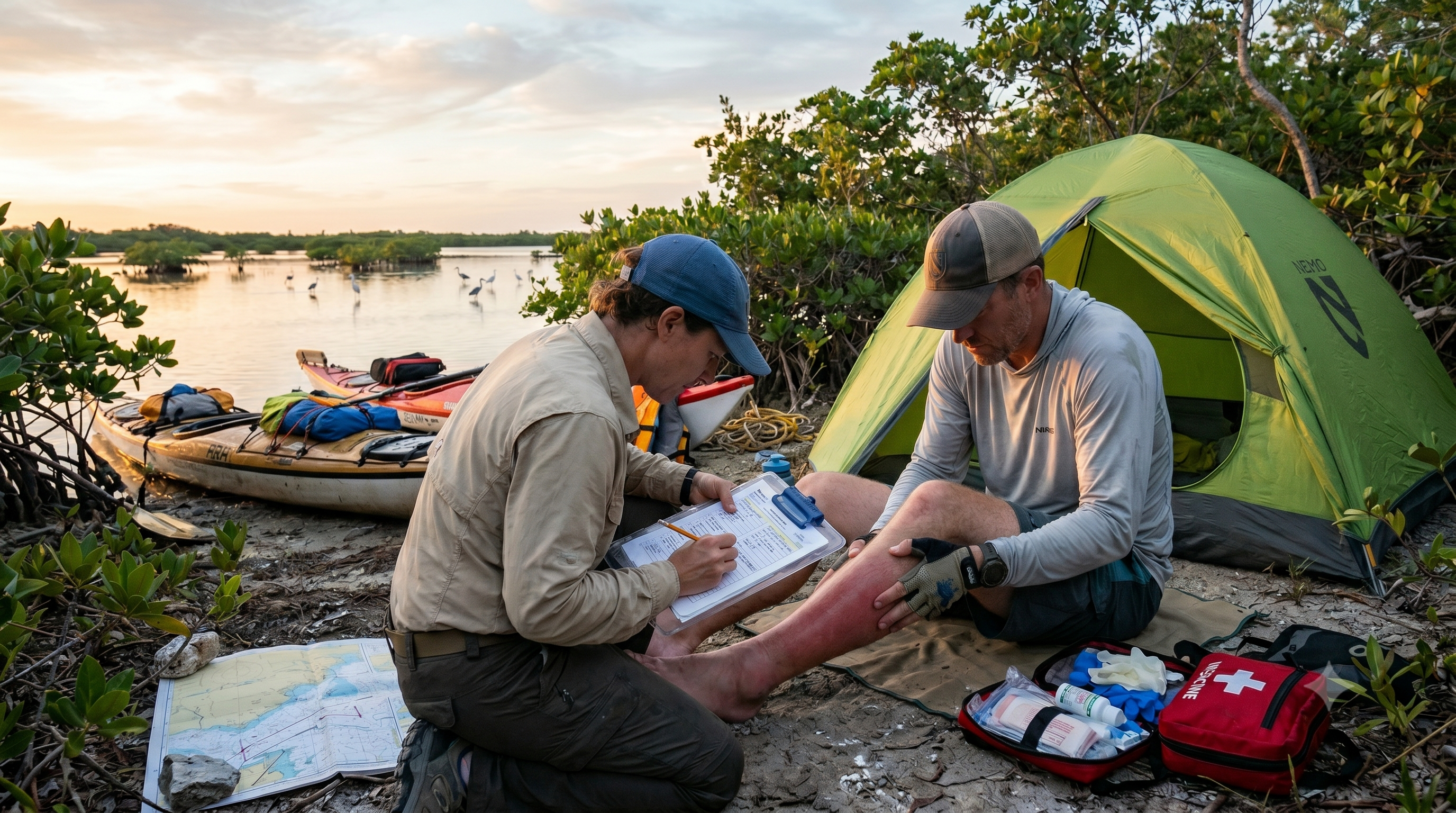
A Brown Recluse Spider Bite, Delayed Reporting, and Evacuation During a Two Week Everglades Kayak Expedition
“In wilderness medicine, the patient rarely gets into trouble all at once. Trouble arrives one small decision at a time.”
As Wilderness First Responders, we spend countless hours learning patient assessment systems, evacuation guidelines, and treatment protocols. Yet many wilderness incidents do not begin with dramatic trauma or obvious emergencies.
More often, they begin with denial.
The purpose of this case study is not simply to teach the assessment of a suspected poisonous spider bite. It is designed to help future Wilderness First Responders recognize a common wilderness hazard that receives far less attention than weather, wildlife, or navigation.
The hazard is the human nature of denile.
This incident occurred during a fourteen day kayak expedition through the Florida Everglades and serves as an excellent training scenario for WFR students learning patient assessment, decision making, risk management, and evacuation planning.
🌅 The Expedition
By Day 10 our expedition had settled into a comfortable rhythm.
Before dawn, camp stirred to life beneath the mangroves. Coffee simmered on camp stoves while paddlers packed sleeping bags into dry bags and prepared for another day on the water.
We had been averaging nearly eight hours of paddling each day.
Fatigue was normal. Sore muscles were normal. Sunburns, bug bites, and aching shoulders were normal.
The wilderness has a way of making discomfort feel routine. Sometimes that routine becomes dangerous.
🕷️ The Bite Nobody Knew About
Five days earlier one member of the group discovered a painful bite on the inside of his right calf.
He believed it was likely a spider bite. He chose not to report it. At the time, the injury seemed insignificant.
He could still paddle. He could still carry gear. He could still contribute to the team.
Rather than mentioning the bite to the team, he quietly began taking ibuprofen for the sore muscle and inflammation from his personal first aid kit. And a few hours later he took some acetaminophen for pain relief.
He assumed the problem would resolve itself. Instead, it quietly grew worse.
“He fell into the trap of convincing himself that time would solve the problem.”
The paddler wasn’t lacking information. He knew he had been bitten. He knew the pain was getting worse. What changed was his interpretation of the evidence. Instead of treating each new symptom as a warning sign, he continually found a reason to explain it away.
🚩 Rationalizing Every Warning Sign
Over the following days additional symptoms appeared.
- The calf became more painful.
- His abdomen began to ache.
- His lower back hurt.
- His chest felt sore.
- His legs throbbed.
Yet none of these symptoms triggered concern. After all, everyone on the trip was sore.
Eight hours of paddling per day provided a convenient explanation for every symptom.
Then another event complicated the picture.
While unloading kayaks at a muddy landing, the paddler slipped and fell. The fall left bruising near the bite site. Now he had an alternative explanation:
- The swelling was from the fall…or so he thought
- The discoloration was from the fall…or so he thought
- The pain was from the fall…or so he thought
Each symptom received a logical explanation. Each explanation moved him farther away from recognizing and sharing the true problem. This is a classic example of normalization of deviance.
The patient repeatedly accepted worsening symptoms as normal because each individual symptom appeared explainable.
🌙 The Night Before the Assessment
On the evening of Day 10, the group noticed subtle changes in our injured paddler (who believed he was not injured).
- The paddler appeared restless.
- He struggled to sit comfortably during dinner.
- After sunset he paced around camp rather than relaxing.
- Throughout the night he slept very little.
The pain had become impossible for him to ignore. Still, he told nobody.
☀️ Day 11: The Patient Finally Speaks Up
The following morning he emerged from his tent looking exhausted.
- His face was pale.
- His movements were slow and deliberate.
When asked how he was doing, he finally admitted there was a problem. He rolled up his pant leg and showed us the wound. At first glance it was obvious that this was no longer a minor injury.
- A large blister had formed at the center of the bite site.
- The surrounding tissue was swollen and bruised.
- The wound appeared significantly worse than anything expected from a simple insect bite.
At that moment the expedition shifted from travel mode to patient care mode.
🎯 The Avoidable Risk
Years ago, I wrote about how paddlers sometimes take avoidable risks. Most readers think of rough weather, strong currents, or poor equipment choices. https://liquidrhythmkayaking.com/2009/05/10/paddlers-sometimes-take-avoidable-risks/
This incident illustrates a different kind of risk. The patient fell into the “It Will Get Better Tomorrow” Trap. Every day he expected the situation to improve.
When it didn’t improve, he found another explanation:
- The pain was from paddling.
- The bruising was from the fall.
- The fatigue was from long days on the water.
- The sleeplessness was from discomfort.
- The fever would probably pass.
Tomorrow is the most dangerous word in Wilderness First Aid.
- Tomorrow delayed reporting.
- Tomorrow delayed assessment.
- Tomorrow delayed treatment.
- Tomorrow delayed evacuation.
By the time he admitted there was a problem, the expedition had already lost its most valuable resource: time.
When teaching first aid remind your students that this case study is not really about a spider bite. It is about recognizing how easily patients can normalize worsening symptoms and how quickly a minor medical issue can become a major evacuation when nobody speaks up.
The spider caused the injury. The avoidable risk was believing that doing nothing was a treatment plan. And when your students ask “what type of spider was it”… It probably was a Brown Recluse. But the biggest issue was the delay…
📋 SOAP Assessment
🗣️ Subjective
Patient reports being bitten on the right calf approximately five days earlier. Patient intentionally chose not to report the injury. Patient states he believed the bite would heal without treatment. Patient reports progressive pain involving:
- Abdomen
- Lower back
- Chest
- Legs
Patient reports severe restlessness overnight and inability to sleep and thought this was all due to all of the paddling. He still finds it hard to believe a spider bite is the main cause of his discomfort. And that maybe he is just dehydrated.
Current complaints include the following:
| 🤕 Severe calf pain 🤒 Fever 🥶 Chills 🤢 Vomiting | 😵 Dizziness 🌡️ Rash 😣 Generalized muscle aches 😴 Fatigue |
👀 Objective
Date of Assessment – Day 11 of a 14 Day Everglades Kayak Expedition
Time: 0700 Hours
Location: Remote Everglades Wilderness Waterway campsite approximately two days from road access.
General Appearance
- Alert and oriented × 4.
- Pale and visibly ill.
- Slept less than two hours overnight.
- Ambulates independently but favors affected leg.
- Reports pain level of 8/10.
Vital Signs
- Pulse: 112 bpm.
- Respirations: 24 breaths per minute.
- Blood Pressure: unknown, no means to check
- Oral Temperature: 101.8°F.
- Skin warm, flushed, and moist.
Bite Site
- Bite located on medial right calf.
- Central blister measuring approximately 4 cm × 5 cm.
- Swelling measuring approximately 12 cm × 15 cm.
- Dark purple discoloration extending 10 cm beyond blister margins.
- Significant tenderness.
- Burning and throbbing pain reported.
- Mild edema extending toward ankle.
Systemic Findings
- Abdominal pain 6/10.
- Lower back pain 5/10.
- Generalized muscle aches.
- Diffuse rash across torso.
- Two episodes of vomiting within previous 12 hours.
- Chills despite warm nighttime temperatures.
- Dizziness upon standing.
- Decreased appetite.
- Poor fluid intake.
- Reduced urine output.
🧠 Assessment
Suspected spider envenomation with systemic involvement.
Patient demonstrates progressive local tissue damage and worsening systemic symptoms.
The development of fever, vomiting, dizziness, rash, increasing pain, and sleep disruption indicate a significant deterioration in condition.
Delayed reporting likely contributed to the severity of the situation.
Patient requires evacuation and definitive medical evaluation.
🚨 The Evacuation Decision
One of the most important lessons for Wilderness First Responders is understanding that assessment and treatment are only part of patient care.
Eventually every responder must answer a simple question:
Can this patient safely remain in the field?
On Day 11 the answer was no. This was no longer a first aid problem. This was now an evacuation problem.
📡 Contacting Emergency Services
In Everglades National Park, emergency response presents unique challenges. There are few roads. Many campsites are accessible only by water. Even highly trained responders may require hours to reach a patient. If cellular service is available, emergency contact can be initiated by dialing:
☎️ #NPS This connects callers to National Park Service emergency dispatch.
Because of our remote location, we also utilized marine communications.
📻 VHF Radio Call
Channel 16 remains the international distress frequency monitored by the United States Coast Guard. One member of our team handled communications while patient care continued.
Initial Distress Call
Expedition Team:
“MAYDAY, MAYDAY, MAYDAY.”
“United States Coast Guard.”
“This is kayak expedition group Liquid Rhythm.”
“We have a medical emergency.”
“We are located within Everglades National Park near Plate Creek Chickee.”
“We have one adult male with suspected spider envenomation presenting with fever, vomiting, dizziness, rash, severe pain, and progressive tissue damage.”
“We are requesting medical evacuation.”
“Over.”
Coast Guard Response
“Liquid Rhythm, this is United States Coast Guard Sector Miami.”
“Provide GPS coordinates, number of persons in your party, and patient condition.”
Expedition Team
“Coast Guard, this is Liquid Rhythm.”
“Our GPS coordinates are…We have eight persons total. With eight, eighteen feet long kayaks, colors are…” the “Patient is alert and oriented but unable to continue travel.”
“We have established camp and are monitoring vital signs.”…”Over.”
Coast Guard
“Liquid Rhythm, remain at your current location.”
“Rescue resources are being coordinated with Everglades National Park.”
“Maintain watch on Channel 16.”
🚁 Preparing For Rescue
Once communication was established, our priorities shifted.
- Continue patient monitoring.
- Protect the wound.
- Maintain hydration.
- Document vital signs.
- Prepare for extraction.
- Keep the patient warm, calm, and reassured.
The goal was no longer treatment.
The goal was preventing deterioration until higher medical care arrived.
🚩 Making Ourselves Visible
Finding a patient in the Everglades can be challenging. Mangrove islands can conceal an entire expedition. To aid rescuers we deployed multiple visual signals:
🚩 Bright expedition flag
🦺 High visibility PFDs, and bright colored kayaks. Coast Guard knew the colors and size of the kayaks they were looking for
🔥 Handheld marine flares
🪞 Signal mirror
💡 Headlamps and flashlights
🔦 Electronic rescue laser flare. Modern laser rescue flares provide a valuable addition to traditional signaling equipment. Unlike pyrotechnic flares, they operate for extended periods and eliminate fire hazards, making them particularly useful for kayak expeditions and maritime rescue situations. I like the “Greatland Laser” product.
🎓 Teaching Points for Wilderness First Responders
When discussing this case with students, consider the following questions:
❓ At what point should the patient have reported the bite? Could we have had more talks about our health each time we sat down to eat as a group?
❓ At what point would you have upgraded the incident from routine monitoring to increased concern?
❓ Which findings most strongly support evacuation?
❓ How did cognitive bias affect the patient’s decision making?
❓ How did delayed reporting reduce available treatment options?
Most importantly:
❓ What actually caused this evacuation?
The answer is not the spider. The spider merely started the chain of events. The true cause was a series of small decisions that delayed recognition of a worsening medical condition.
As Wilderness First Responders, our responsibility extends beyond treating injuries. We must also recognize when human nature is becoming part of the emergency. In the wilderness, time is often the most valuable medical resource available.
Once time is lost, it can never be recovered.

