
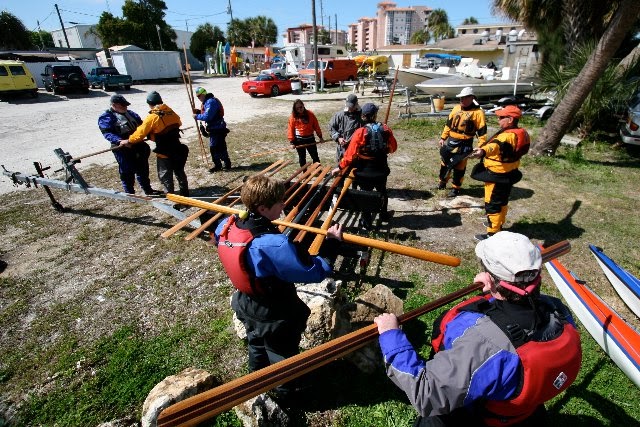
Start here: East and West Greenland are useful historical labels. To understand how a kayak will behave, examine the particular hull, its fit, the intended load, and the paddler. Regional names alone cannot choose a boat for your trip.
I love history, and I find comfort in nature. Greenland kayaks bring those interests together, but affection for a design can run ahead of understanding it. I have done that myself.
Two ideas deserve a closer look: that all Greenland kayaks are alike, and that a Greenland inspired boat must therefore be the best boat for every paddler.
East and West are starting points
Regional names help describe historical kayaks, but they do not replace the record of a particular boat. A useful comparison identifies where and when it was built, its dimensions, its builder and user when known, and the purpose for which it was made.
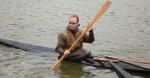
The photograph above was identified in my original archive as an East Greenland style qajaq. It illustrates the boat I encountered, rather than every kayak from that region.
Neither region can be reduced to one kind of water or one predictable set of handling qualities. Read the record of the individual boat alongside its setting and intended work.

What I look at in the actual boat
Deck height affects clearance for movement, including leaning back during a roll. Rocker, the lengthwise curve of the hull, is one influence on turning and tracking. Width, length, hull shape, trim, and load interact with it. No single feature settles the question.
A low deck does not by itself prove that a kayak is unsuitable for rough water. Hard chines do not eliminate weathercocking. Moving my weight can change how a boat responds, but it does not grant immunity from wind. The weather has never accepted that arrangement.
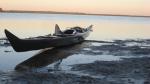
My NDK Greenlander Pro is a modern sea kayak. It is part of my own paddling experience, not a museum specimen establishing the shape of all West Greenland kayaks.

Sean Fitzgibbon in a CLC Shearwater 17, another modern boat pictured in my original comparison. A contemporary design can draw on traditional ideas without serving as a historical type specimen.
A living tradition
I have learned to throw a traditional style harpoon from my kayak. That practice helped me explore the connection between equipment, balance, and recovery. It did not give me the experience of a Greenlandic hunter.
Mark Molina, with whom I took private instruction, wrote of Greenland kayaking that “it is evolving, as it has been for centuries”. That is a useful reminder when I look at a boat and feel tempted to make its regional label do all the explaining. Source: Mark Molina’s own account of the 2003 Greenland National Kayak Championships, The Masik, Qajaq USA, Fall 2003, volume 1, issue 3. Read the surviving issue transcription.
Greenland kayaking continues through teaching, building, clubs, competition, and other living practices. Qajaq USA’s account of Qaannat Kattuffiat is a useful introduction to that continuing work.

The comparative illustration above is retained with its original source credit. For historical study, consult documented boats and their individual records. P. Scavenius Jensen’s The Greenland Kayak and Its Accessories is one historical reference, to be read in the context of its date and terminology.
| What to examine | What it helps you assess |
|---|---|
| Fit and deck clearance | Comfort, control, exits, and room for movement |
| Hull shape and rocker | Turning and tracking alongside load and trim |
| Expected trip load | How the boat handles with your equipment aboard |
| Practice in suitable conditions | Whether the complete boat and paddler arrangement suits the work |
Choose the boat for the work
The best boat is the one that fits the water, fits the paddler, and fits the purpose of the trip. I still stand by that part of the original article.
Try it with the load you expect to carry. Check comfort, control, exits, and recoveries. A beautiful history is worth studying. A boat that suits the journey is worth paddling.
From Florida to New Zealand: The Kiwi Association of Sea Kayakers includes this article in its KASK Info Kit, quoting my original advice to choose a kayak for the water, the paddler, and the purpose. I am glad that practical idea has found a place in another paddling community’s resources.
Also referenced by CNC Kayaks: The CNC Kayaks Origins page names me and links to this comparison in its discussion of the Shrike design’s Greenland influences. Readers can explore that account alongside this article’s revised discussion of individual boats, paddlers, and conditions.
Further historical reading: Mike Buckley’s “Valley Nordkapp” in UK Sea Kayak Guidebook, last updated March 8, 2016, links to this article in its discussion of Greenland kayak types. Readers interested in the Nordkapp’s design history can follow that reference alongside the revisions noted here.
Explore my Greenland kayaking collection, or visit Classes & Prices to arrange instruction.
Editorial note: This older article has been revised to correct technical claims and update links. Its original publication date and photographs are retained.
For a club or symposium, ask me to teach a Greenland paddling clinic. For individual practice, compare my Tampa Bay lessons.


Leave a Reply