
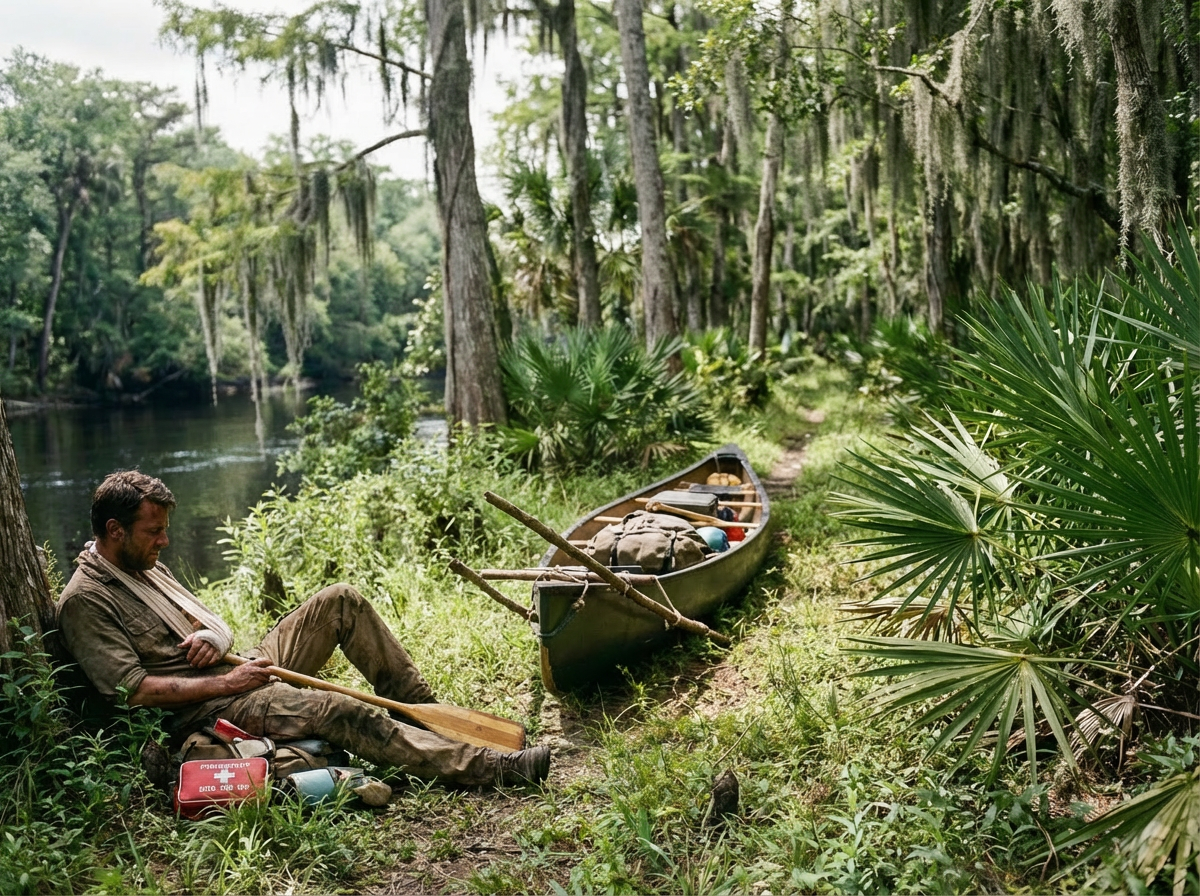
🏕️ “Murphy’s Worst Day on the Trail”
Here’s a SOAP* story written for a Wilderness First Aid, WFA, audience. This is a medically grounded, narrative-driven story. This is designed to naturally discuss the teaching points for bruise, contusion, hematoma, crush injury, and Battle’s sign in a single coherent patient encounter.
SOAP – stands for Subjective, Objective, Assessment, and Plan. It is a method used for documenting patient information in a structured way.
SCENE: Day 3 of a 5-day canoe camping trip. Remote river corridor, 18 miles from the nearest trailhead. Your group of eight has just finished portaging a 400-meter section of slippery, root-tangled trail.
📋 S — Subjective (What Murphy tells you)
Murphy, a cheerful 34-year-old male, is sitting on a log looking embarrassed. “I’m fine, I’m fine,” he insists, waving you off. “The canoe just got away from me on that last portage.”
He explains that the empty canoe, roughly 60 lbs, shifted on his shoulders, he lost his footing on a wet root, and the canoe pinned him against a tree before he could get out from under it. He was down for “maybe two or three seconds” under the weight.
He’s complaining of:
- Pain in his left thigh — “like a deep ache, not a cut or anything”
- Headache — “probably just the sun”
- Left ear feels weird — “kind of full, like after swimming”
- His paddling partner adds: “He smacked the left side of his head pretty good on the tree when he went down.” and “he flailed around like a turtle stuck on it’s back before I could get to him”
Murphy denies loss of consciousness. He denies neck pain. He has no relevant medical history, no medications, no allergies. Last meal was three hours ago. He drank about a liter of water this morning.
🔍 O — Objective (What you find)
You conduct a head-to-toe exam. Here’s what you find:
Head: A tender, raised, boggy (soft, spongy, fluid filled) lump above his left ear; it’s roughly the size of a golf ball, and already showing a bluish tinge at the margins. Murphy winces when you palpate it.
Peering inside his left ear canal with your headlamp the ear canal itself looks clear. Behind the ear is faint purplish bruising, just below the mastoid process. The discoloration is unmistakable.
P.E.R.R.L. = Pupils: Equal, round, reactive to light. No facial droop.
Hands – Grip strength equal bilaterally.
Abdomen: Soft, non-tender. No guarding.
Left thigh: Significant swelling already developing mid-thigh. Skin is intact — no laceration, no abrasion. Firm to the touch, noticeably larger in circumference than the right. The skin over it is beginning to show early reddish discoloration. Murphy rates pain 6/10 with palpation, 3/10 at rest. Distal PMS (pulse, motor, sensation) intact — he can wiggle his toes, feels you touch his foot, and you can palpate his dorsalis pedis.
Vital Signs:
- Pulse: 88, strong and regular
- Respirations: 16, unlabored
- Skin: warm, pink, dry
- Mental status: Alert and oriented x4, slightly anxious
🧠 A — Assessment (What you think is going on)
Three distinct closed wound problems, each worth naming:
1. Scalp hematoma — the golf-ball lump above his ear. Blood has collected between the scalp and the skull in a defined, palpable pocket. The overlying skin is intact.
2. Battle’s sign (suspected) — the purplish bruising behind the ear over the mastoid. This ecchymosis, appearing after a direct blow to the lateral skull, is a classic delayed indicator of a basilar skull fracture. It’s early — Battle’s sign typically takes 12–24 hours to fully develop — but in the backcountry, you’re not waiting to find out.
3. Crush injury / hematoma of the left thigh — the canoe’s weight compressed the soft tissue of the thigh against underlying muscle and bone. The result is a combination of a contusion (diffuse bruising of the muscle and tissue) and a developing hematoma (a localized collection of blood within the muscle compartment). The swelling will continue to expand. You must watch for signs of compartment syndrome: increasing pain, tightness, paresthesia, or loss of distal PMS.
🚑 P — Plan (What you’re going to do)
Immediate:
- Keep Murphy still and calm.
- Apply a cold compress (river water in a stuff sack) to the scalp hematoma — 20 minutes on, 20 off — to slow local bleeding and swelling.
- Firmly wrap the left thigh with your elastic bandage to provide compression and limit hematoma expansion; elevate the leg when he is resting.
- Do NOT give ibuprofen or aspirin — both impair platelet function and could worsen internal bleeding.
- If he wants to take something for the pain, and he has it in his first aid kit the taking of Acetaminophen (if available and no contraindications) is acceptable for pain. You are not trained to administer medications.
Monitoring:
- Serial neuro checks every 15–30 minutes: pupils, grip strength, mental status, headache progression.
- Serial thigh checks: measure circumference with a cord or bandage, watch PMS, watch for escalating pain.
- Watch for vomiting, deteriorating mental status, or unequal pupils — any of these = urgent evacuation decision.
Evacuation: Murphy needs evacuation. The suspected Battle’s sign alone — even without confirmed loss of consciousness — warrants evaluation for basilar skull fracture. This is a serious evacuation (non-ambulatory preferred; litter if available). He should not paddle stern, should not carry loads, and should be monitored continuously.
Notify the group. Activate your communication device. Send the most experienced paddler with your trip plan ahead if possible.
🗣️ Instructor Debrief Hooks
After reading the story, you can pause and ask:
- “When I described the lump on his head — what type of closed wound is that, and what’s happening physiologically?” → Hematoma vs. contusion
- “Why did I specifically tell you NOT to give ibuprofen?” → Antiplatelet effect, worsening hemostasis
- “Battle’s sign — has anyone seen this before? Why does it appear there?” → Basilar skull fracture, tracking blood through fascial planes
- “The thigh is swollen and the skin is intact. What are we worried about developing over the next few hours?” → Compartment syndrome, monitoring distal PMS
- “What’s the difference between what Murphy has in his thigh versus a bruise you’d get bumping a coffee table?” → Mechanism, depth, volume of blood — contusion vs. crush injury hematoma
The end of the Story
Murphy’s embarrassed grin fades when he realizes his “fine” situation requires a sat phone call and a litter carry. He should’ve let someone help him carry the canoe.
This narrative hits bruise, contusion, hematoma, crush injury, and Battle’s sign in a single coherent patient encounter, with built-in WEMS rationale for each decision. I hope this helps when you teach this skill to others.
WEMS – Wilderness Emergency Medical Services

