
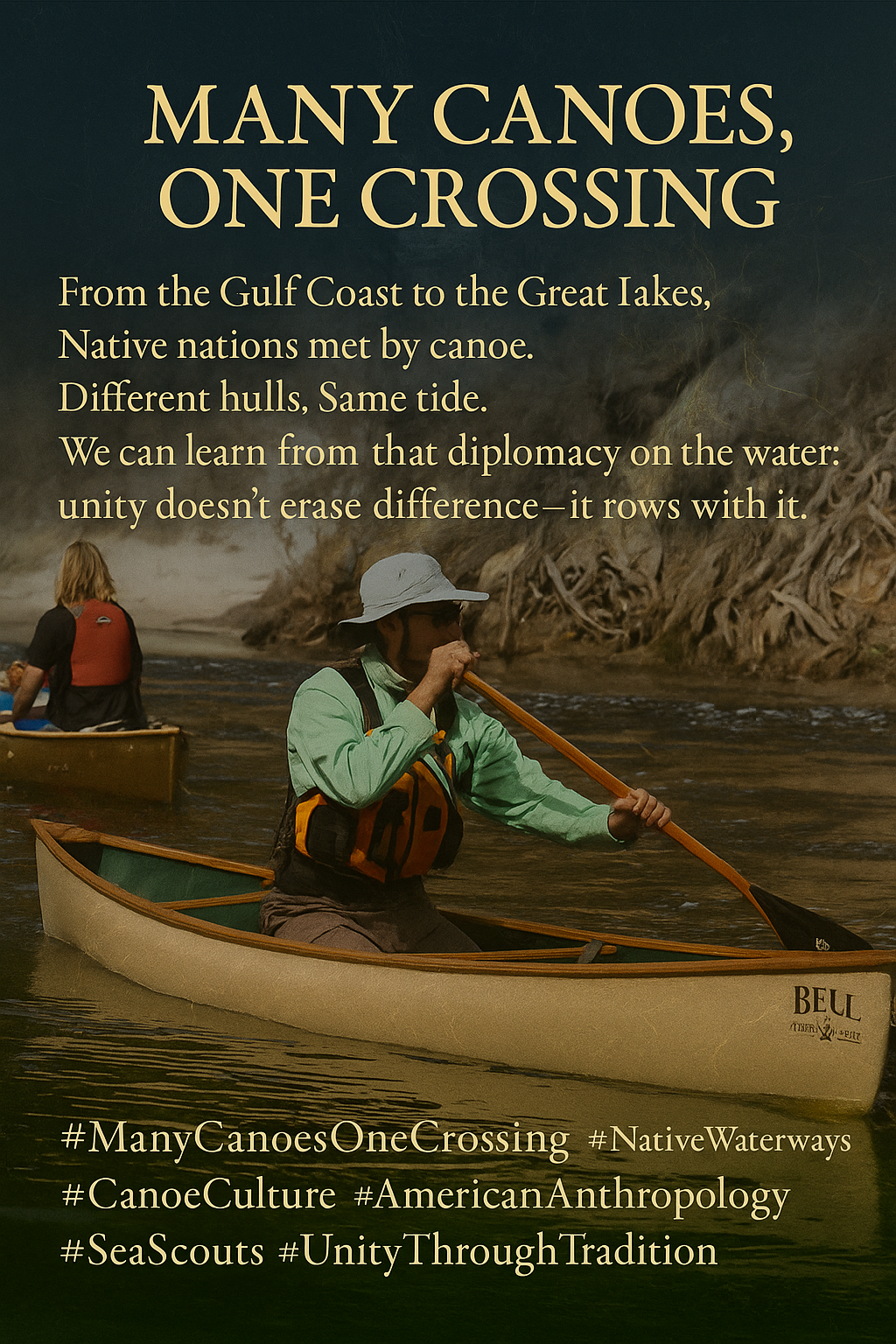
From the Gulf Coast to the Great Lakes, Native nations met by canoe.
Different hulls. Same tide.
Before America drew borders or built roads, diplomacy happened on the water. Across the continent, rivers served as blue highways of dialogue. Canoes, carved and sewn in every shape imaginable, carried trade, stories, songs, and peace offerings. The people who paddled them: Choctaw, Ojibwe, Creek, Seminole, Haudenosaunee, and countless others. They all understood a truth our modern representative republic has nearly forgotten: unity doesn’t erase difference. It rows with it.
Today, as our nation seems to paddle against itself; left versus right, urban versus rural, red tide versus blue wave. It’s worth revisiting river wisdom. Canoes have always been classrooms for coexistence. They remind us that balance is not born from uniformity but from shared rhythm in a moving current.
So, how can we learn from diplomacy on the water, where unity doesn’t erase difference it rows with it?
Three lessons rise like landmarks on a familiar route.
🪶 By respecting every paddle’s rhythm and letting it find its own stroke in the current
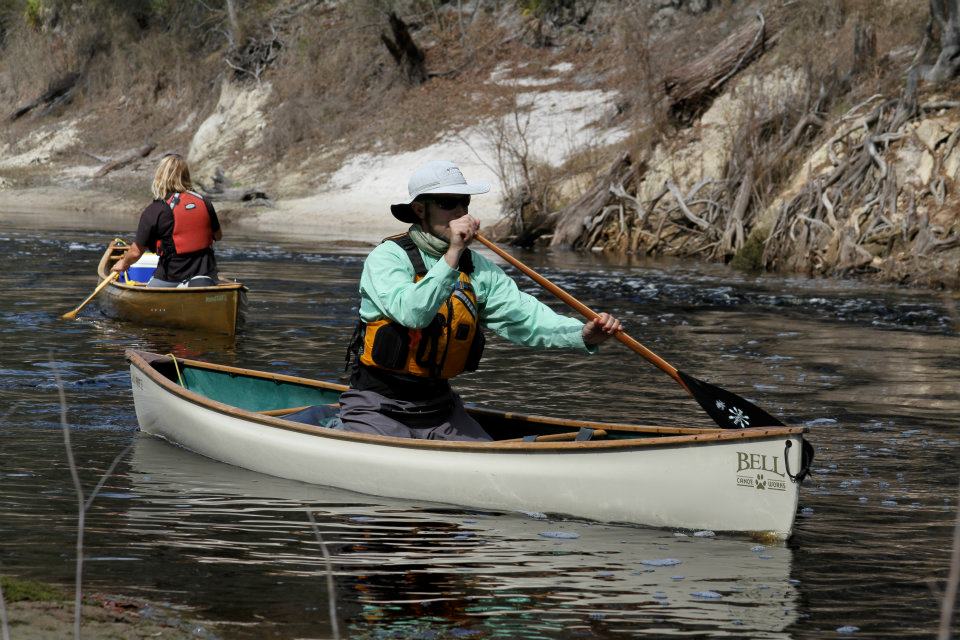
A canoe crew that demands identical strokes will never move far. Every paddler, from bow to stern, has a different reach, cadence, and pull. The art is not to force sameness but to find harmony in diversity.
Among the Native nations, each tribe’s canoe reflected its home waters. The broad-beamed birch for northern lakes, dugout cypress for Florida swamps, and bark-sewn marvels for the rivers of the interior. Each was a reflection of geography, spirit, and necessity. When they met, they didn’t argue about whose canoe was right; they met in respect for each craft’s purpose.
Anthropologically speaking, this was a living system of interdependence. Trade routes between nations weren’t only for goods they were for ideas, kinship, and ritual. The diplomacy of the paddle required humility. No one crew owned the current. They were guests upon it.
Modern America could use a return to that mindset. We’ve fallen into the trap of mistaking unity for uniformity, believing that agreement is the only form of peace. But paddlers know better. You can’t sync an expedition by shouting “paddle the same!” You do it by listening for rhythm, adjusting, and trusting the shared direction of the boat.
In life, as on the water, the rhythm of the other paddler is not a threat it’s a contribution.
⚓ By steering together toward shared horizons instead of fighting over the eddy lines
Anyone who’s steered a canoe through twisting current knows that not every turn is worth fighting. The stern paddler’s job is to read the water, anticipate the flow, and guide the canoe not with domination, but with trust. Overcorrect, and you spin. Argue about every ripple, and you capsize.
When Native envoys met by canoe, their goals were not to erase difference but to create passage to navigate together toward a horizon of coexistence. The Haudenosaunee Two Row Wampum Belt, one of the most beautiful expressions of this philosophy, depicts two parallel lines representing a European ship and a Native canoe. The two travel side by side, neither steering the other’s vessel, both respecting the same river. That’s not weakness. It’s wisdom.
In today’s terms, that means learning to steer toward shared horizons clean water, honest dialogue, safe communities, and healthy families without trying to force everyone into the same hull. The eddy lines of political life those swirling pockets of resentment and ideology are seductive. They seem safe. But they hold you in place while the real current moves on.
In expedition life, a team that argues about the current loses sight of the destination. The secret is to fix your eyes on the bend ahead the shared horizon and paddle through the noise.
The river doesn’t wait for consensus. It rewards motion.
🌅 By remembering that calm waters come from balance, not sameness
A canoe at rest is a paradox. It’s in motion even when still, rocking gently on the pulse of the world. Its balance doesn’t come from rigidity but from responsiveness—tiny adjustments, constant awareness, trust in equilibrium.
The same is true for any society worth keeping. The calm we crave is not the silence of identical opinions but the balance of respectful tension. A nation, like a canoe, needs weight distributed wisely. Too much to one side, and the world tilts.
In Florida, where the tides breathe through mangrove roots and hurricanes reshape the shoreline every season, balance is a living art. We learn to adapt. To rebuild. To hold fast to what matters most. When the storm hits, nobody asks what party you belong to—they ask who’s got rope, who’s got food, and who can paddle the floodwater. Crisis reminds us that unity is not built on agreement—it’s built on dependence.
Native watercraft embody that lesson. A birchbark canoe is light enough for one person to carry, yet strong enough to cross entire watersheds. It flexes, bends, and breathes. It survives because it yields.
Calm, in this way, is not the absence of difference. It’s the mastery of it.
The Republic as River
Our ancestors understood that America’s destiny was tied to its waters. The earliest explorers followed the same routes the Native peoples had known for centuries. The Mississippi, the Hudson, the Suwannee—each became a ribbon binding many cultures into one long story.
When the Founders chose E Pluribus Unum, they were echoing that natural truth: from many, one. From many rivers, one sea. From many canoes, one crossing.
But they also knew what paddlers know—unity is not an endpoint. It’s a discipline. It must be practiced, renewed, and protected.
To stay in balance, we must keep respecting each paddle’s rhythm, steer toward shared horizons, and remember that calm comes from balance, not sameness.
Every river traveler knows that the strongest crews are the ones who argue on land but paddle as one on the water. They can disagree on direction, even grumble over leadership, but when the current demands it, they pull together. That is how you survive the rapids. That is how you make it home.
Field Wisdom
“When the current divides, listen for the song of the deeper water. It will always call you back to the middle.”
From the Gulf Coast to the Great Lakes, Native nations once met by canoe. They did not meet as conquerors or converts, but as travelers with shared dependence on the same living river. That spirit is still possible. The current hasn’t vanished—it’s only waiting for us to remember the way.
If we can honor difference without fear, row with rhythm not rage, and trust that every paddle matters, then we can still find the far shore together.
Different hulls. Same tide.
Many canoes. One crossing.
#ManyCanoesOneCrossing #EPluribusUnum #NativeWaterways #LiquidRhythmKayaking #UnityThroughTradition #AmericanAnthropology #CanoeCulture #FloridaBushcraft #OutdoorLeadership
 Liquid Rhythm Adventures' Journal