

Before America had highways, it had rivers. Before it had parties, it had paddlers. The first people, tribes, traders, and explorers moved by current and tide, guided by instinct, rhythm, and trust. When the Founders adopted E pluribus unum, “Out of many, one,” they weren’t just drafting a motto. They were describing the physics of survival in a land defined by water.
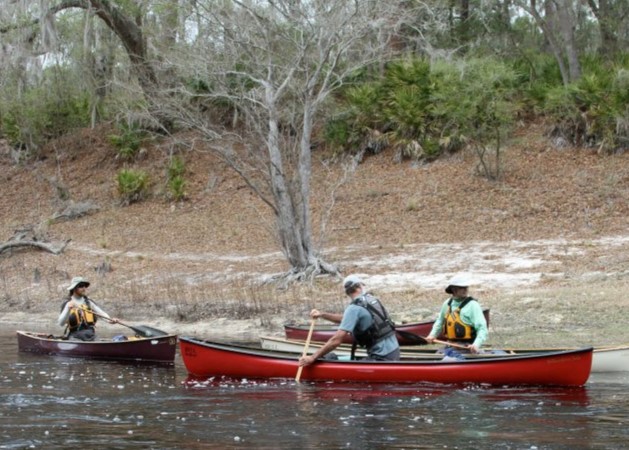
I’ve paddled rivers where clarity vanishes in a heartbeat. One bend looks calm, the next reveals a hidden log jam or whirlpool. In those moments, when a tandem canoe wobbles between control and chaos, you learn fast that unity isn’t about agreement, it’s about motion. Shared, determined, living motion. That’s as true on the Suwannee as it was in Philadelphia in 1776.
So when the question arises “When the current gets rough and paddlers disagree on direction, what truly keeps the canoe, and a nation, moving forward?” It’s not just a metaphor. It’s the oldest American lesson there is. Let’s take a look at three ways we might answer it. And how all three different answers are incomplete and yet when they are combined they become three pillars of a tripod.
🛶 Perfect harmony in every stroke
Agreement on every move ensures no wasted effort.
There’s a kind of peace in perfect synchronization. The kind you see when two paddlers glide silently through a glassy cove at dawn. The strokes are matched, blades catch and release in rhythm, and the canoe hums like a tuning fork. It’s beautiful.
But try to hold that perfection for an entire expedition and you’ll wear yourself out. Water changes, wind shifts, and even the strongest paddler tires. Harmony is a worthy goal, but demanding total agreement can become a tyranny of rhythm. One paddler might need to adjust for current; the other, for balance.
In the early Republic, there were those who sought exactly that kind of unity. The Federalists, for instance, believed order and harmony were the only way to hold a fragile union together. And to their credit, they kept the canoe upright through the first waves of nation-building. But history teaches that too much insistence on uniformity risks stifling the very creativity and debate that keep a democracy dynamic.
On the water, it’s the same. Harmony is a dream. The real art of paddling is learning when to let go of perfect rhythm and allow for adaptation.
⚓ Mutual trust and timing
Belief that your partner’s pull, even if different, keeps balance and motion alive.
If harmony is the dream, trust is the practice. I’ve seen tandem partners bicker in a canoe until both end up soaked and silent. I’ve also seen partners who read each other like tide and moon; no words, just rhythm and faith.
When one paddler braces, the other glides. When one steers, the other powers. It’s not identical movement it’s complementary. The magic lies in the timing, the trust that even a different stroke has purpose.
That’s the heart of the Republic at its best. The Founders disagreed on almost everything: central government, religion, trade, slavery. They trusted in a shared horizon. The Constitution wasn’t a document of perfect agreement; it was an act of synchronized courage. They trusted the boat would hold.
Modern America could learn from that rhythm. We’re divided into left and right, coastal and inland, red and blue. Our strength, like a tandem team, depends on faith in the unseen stroke of the other. You don’t have to mirror it. You just have to believe that both of you still want to stay upright and move downstream.
The anthropologist in me sees this in the canoe diplomacy of Native nations. Across the Great Lakes, the Gulf, and the St. Lawrence, trade and negotiation were done by water. Nations met in canoes that were distinct in design but united in purpose. Birchbark, dugout, skin-on-frame canoes. Different hulls carrying them along the same current. That’s what made America possible before there even was an America.
Trust doesn’t mean surrender. It means grace in uncertainty. On the river and in the Republic, that’s what keeps the bow pointed toward home.
🌊 A strong captain giving orders
Leadership through authority guarantees unity of motion.
There’s no question that in turbulent water, leadership matters. Every canoe needs a stern paddler. The one who sees the river ahead, calls the strokes, and steers the course. The bow paddler, meanwhile, sets the pace and watches for obstacles. It’s a dance of direction and drive.
Strong leadership isn’t about domination. It’s about balance. Reading the water, knowing when to command and when to listen. History reminds us that the same holds true for nations. George Washington was no tyrant, but he understood that a Republic without direction would drift into the rocks.
In stormy times, people crave a firm hand on the tiller. But a canoe captain who doesn’t trust the bow paddler to see what’s coming will miss half the river. Leadership without partnership is just paddling in circles.
True authority in both canoe and country comes from shared responsibility. The best leaders don’t silence other strokes; they set the rhythm that lets others find their place.
The River That Binds
If I’ve learned anything from decades of paddling Florida’s backwaters and teaching others to do the same, it’s this: the river is always stronger than the paddler. You don’t conquer it. You learn to move with it.
In politics, we often imagine that unity means choosing one side of the current and pushing everyone else into it. That’s not unity, that’s control. Unity is about shared motion through uncertainty. It’s knowing that sometimes your partner’s stroke will splash you in the face and still being grateful they’re in the boat.
When the current divides, when the waters rise and the nation feels like it’s spinning in eddies of outrage and fear, remember what keeps both canoe and country afloat: trust, timing, and grace.
A Republic, like a river, survives because people keep paddling together even when the current pulls at their differences. And though our strokes may not always match, the motion forward is what matters.
Field Wisdom:
A nation, like a tandem canoe, moves best when paddlers pull together and steer from trust.
We don’t need perfect harmony. We need steady courage.
We don’t need identical strokes. We need shared motion.
And we don’t need to win every argument. We need to keep the canoe moving.
From the Gulf Coast to the Great Lakes, the rivers that shaped America are still flowing. They remind us that every generation has to find its own stroke, learn its own balance, and trust again in the vessel that carries us all.
The first paddle stroke of a Republic wasn’t flawless; it was a beginning. A promise written in the language of water: out of many, one. Out of disagreement, motion. Out of motion, hope.
So grab your paddle. The current’s waiting.
 Liquid Rhythm Adventures' Journal