
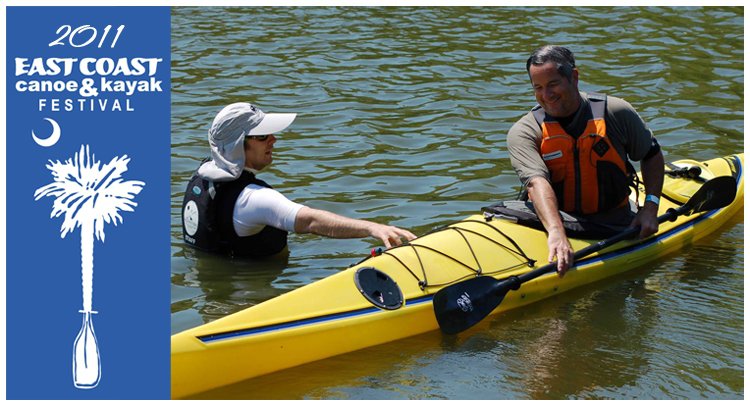
How a photograph from the 2010 East Coast Canoe and Kayak Festival in Charleston, South Carolina, later used to promote the 2011 festival, brought back a conversation about a skill that is often celebrated for the wrong reason.
Charleston, April 2010
From April 16 through 18, 2010, I was at James Island County Park for the twentieth annual East Coast Canoe and Kayak Festival. I was teaching as a guest instructor with H2Outfitters, working alongside Jeff Cooper and Cathy Piffath. Somewhere in that weekend a photograph was taken of me doing what I have spent a good part of my paddling life doing: working with another paddler in the water.
The photograph was later used in promotional material for the 2011 festival. The large 2011 lettering belongs to the advertisement, not the date of the lesson. That distinction is worth keeping straight, especially as old paddling photographs become part of our history.
When I look at that image now, I think less about the roll itself and more about what should happen before a paddler ever needs one.
Everybody wants to roll
After all these years I am still amazed at how often a student arrives wanting to perfect a roll without first having a dependable low brace or high brace. I understand the attraction. A roll is dramatic. A kayak disappears beneath the surface, the paddle moves, and the paddler comes back into daylight. Everybody can see the result.
Bracing is quieter. A good brace may look like almost nothing happened. The boat tips, the paddler responds, and the conversation continues. There is no applause for the capsize that never occurred.
But that quiet moment is where much of the real seamanship lives.
Before the boat goes over
A low brace is one of the early answers to lost balance. A high brace can help recover from a deeper lean, but it demands sound technique and care for the shoulder. Neither is a magic shield. The boat, body, paddle, and water must work together, and the safest choice depends on the conditions.
Rolling belongs in the same family of skills. It is what we practice when the capsize has already happened. A wet exit, assisted rescue, and self rescue remain essential because no roll is guaranteed. I teach all of these skills, and I do not believe one impressive maneuver makes a complete paddler.
Whitewater paddlers have a particularly persuasive reason to avoid an unnecessary capsize. The bottom of the river is not particularly interested in how beautiful your roll is. Rocks and shallow water can make going upside down a dangerous proposition. Sea kayakers have their own hazards: surf, shoals, reefs, oyster beds, pilings, and loaded boats. Sometimes a brace prevents trouble. Sometimes the force is greater than the brace can manage. Sometimes the smartest decision was made well before the boat reached that water.
Before rolling became a sport
My interest in traditional Greenland qajaq skills has also shaped how I teach. For Inuit hunters, recovery skills belonged to a working boat and a demanding environment. A paddle might be lost. A hand might be occupied with equipment. A hunting line could restrict movement. An arm could be injured. A hunter might be pulled off balance. Different recoveries answered different problems.
These were not merely curiosities invented for a swimming pool. In Arctic waters, an unsuccessful recovery could be fatal, and a hunting household depended upon skill, cooperation, and the successful provision of food. That does not mean every named Greenland roll can be traced to one specific emergency, or that traditional paddlers never practiced for enjoyment or prestige. It means the repertoire makes more sense when we remember the working life of the qajaq.
The variety of Greenland recoveries becomes much more understandable when we stop asking which roll looks hardest and start asking what could go wrong during a hunt. Qajaq USA’s traditional skills descriptions provide a useful starting point for that history.
The instructor in the chair
That weekend I was also a student. I took a class with Derek Hutchinson. There were twelve of us sitting in kayaks on the lake while Derek taught from a chair on the bank. That image has stayed with me as clearly as the promotional photograph.
He was not paddling alongside us to demonstrate every movement. He was watching. His focused observation and the particular words he chose opened my eyes to a different way of teaching. A carefully chosen instruction could direct a student’s attention to something happening in the boat and create room for guided discovery. The student still had to find the movement.
I have carried that lesson into my own instruction. It is tempting to show a student what I can do. It takes more care to observe what the student is actually doing, say what matters, and give that paddler a chance to recognize the difference. Hutchinson taught me something about teaching, not merely about rolling.
Derek Hutchinson and a familiar idea
During the 2010 festival I remember talking with Derek Hutchinson, whose teaching and writing influenced generations of sea kayakers. I will not pretend to reproduce a conversation from sixteen years ago word for word. What I remember is the substance of his observation: a perfect roll can mean the brace that might have kept the boat upright did not succeed.
That stayed with me, partly because it was an idea I had already been wrestling with. On September 15, 2009, I published a short Liquid Rhythm journal entry titled “Rolling always looses against the perfect brace.” The original feeling is still there, as are the thoughts of the instructor I was then. The old journal is not something I want to erase and rewrite to make myself look wiser. It is evidence of how my thinking developed.
Hutchinson did not hand me a philosophy that weekend. As I remember it, he gave a familiar lesson a sharper edge.
What I teach now
I still teach rolling. I still love traditional Greenland techniques. I want students to develop calm, reliable recovery skills and to understand that a failed attempt is information, not disgrace. But I also want them to learn how to sit, edge, balance, brace, wet exit, and work with the kayak rather than fight it.
Before we practice a roll in the water, I take time on land to rehearse the position and the spray skirt release. We repeat the movement, then practice the actual release in controlled water before moving into rolling preparation. Confidence should come from a practiced exit and a sensible progression, not from pretending that fear does not exist.
There is a difference between teaching a maneuver and developing a paddler. The maneuver may take a lesson. The judgment takes longer.
Perhaps my title is unfair. Not every capsize begins with a mistake, and not every capsize offers time for a brace. A wave can simply win the argument. That is precisely why the roll matters. Prevention and recovery are not rivals. They are layers of the same seamanship.
Brace because staying upright is preferable. Roll because sometimes staying upright is no longer an option. Practice both because the water gets the final vote.
For the cultural and historical side of this Charleston photograph, see my companion essay at FloridaOATS, “What the Water Taught Us to Remember.”
Historical notes and further reading
2010 festival contemporary notice · Festival history · Qajaq USA


Leave a Reply