
A SOAP Narrative for Wilderness First Aid, with a Wilderness First Responder instructor discussion.
The experience behind the scenario. The inspiration came from my paddling partner, Sean Fitzgibbon, a local park ranger. Sean described puss caterpillars as a regular seasonal presence at Fort De Soto Park.
He was wearing safety glasses while pruning an oak when something fell onto his temple. It slid down his cheek and fell off his chin. Sean described immediate, intense burning and throbbing pain at the exact site of contact. He saw the caterpillar on the ground, recognized what had happened, and made a radio call to his coworkers. Sean reported that the rash from the sting lasted almost a week.
That call belongs in the lesson. He recognized the problem and let somebody else know. The pruning could wait.
Training adaptation. Sean’s experience inspired this constructed teaching case. Sam is a role play name; his campsite, age, weather, medical history, examination and vital signs are supplied for simulation. The optional anaphylaxis branch is a separate exercise, not part of Sean’s reported experience.
The campsite can wait
Camp was nearly packed. Breakfast was finished, the small loose things were finding their way into dry bags, and the tarp over the hammock was ready to come down. This is the part of a paddling morning when everybody has a job and nobody wants another one.
Then something small fell from the tarp and made one grown man forget all about breakfast.
For this exercise, picture a Florida hammock campsite in spring or fall. It is 0810. The air is 78°F, humid and partly cloudy. Sam, a 52 year old paddler, is now kneeling near his canoe, that’s secured to the same tree as his hammock. He was reaching up to gather the tarp edge to take the tarp down. A fuzzy caterpillar drops onto his right ear, slides across his right cheek toward his mouth, and falls away.
He jerks back and reaches for his face and goes down on one knee.
“Something just fell on me. It feels like a red hot wire across my face!”
The pain has his full attention. Your job is to make sure it does not take all of yours.
Something soft looking, something worth leaving alone
The suspected animal is a puss caterpillar, Megalopyge opercularis, the larva of the southern flannel moth. Its soft appearance conceals venomous spines. A photograph may help with identification, but nobody needs to pick it up to settle the question. Poison Control explains caterpillar contact injuries and how to obtain specific advice.
Stop packing and listen
Student stopping point: Read the scene and Sam’s opening complaint aloud, then stop here. Students begin their assessment before seeing the findings, completed SOAP record or instructor materials below.
Case findings follow. Help Sam reach a secure assessment position without creating any additional problems or spreading and worsening the caterpillar material. Training setup and actor instructions appear after the case.
Sam reports burning along his right ear and cheek, with tingling near the right corner of his mouth. He initially denies trouble breathing or swallowing, nausea, dizziness and itching elsewhere. He speaks normally and manages his saliva. The redness and mild swelling remain local.
S | Subjective
Sam describes immediate severe burning after contact with a fuzzy caterpillar on the right ear and cheek. He rates the initial pain 8/10. Tingling is near the right side of his mouth. He denies the initial systemic symptoms listed above.
| SAMPLE | Supplied scenario history |
|---|---|
| Signs and symptoms | Burning pain, redness and localized swelling of right ear and cheek; tingling near mouth. |
| Allergies | No known allergies or previous anaphylaxis in the script. |
| Medications | Lisinopril for blood pressure. Ask about dose, last use and other medicines; these details are not supplied. |
| Pertinent history | Hypertension; no asthma in the script. |
| Last intake | Breakfast and water about one hour earlier. |
| Events | Caterpillar fell during tarp removal, contacting the right ear and cheek toward the mouth. |
O | Objective
At 0810, Sam is alert and oriented to person, place, time and event. He appears uncomfortable and anxious. His right ear and cheek show localized redness and mild swelling. No retained spines are obvious, although that does not exclude microscopic material.
The initial script supplies a patent airway, normal speech, handling of secretions, clear lungs and unlabored breathing. There are no generalized hives. Skin is warm, pink and slightly sweaty.
Ask specifically about eye, mouth and ear canal exposure; none is established in the baseline.
| Time | AVPU | Pulse, bpm | Respirations, per minute | BP, mmHg | SpO₂ | Pain |
|---|---|---|---|---|---|---|
| 0810 | Alert | 92 | 18 | 138/84 | 98% | 8/10 |
| 0815 | Alert | 96 | 18 | 136/82 | 98% | 7/10 |
| 0820 | Alert | 88 | 16 | 134/82 | 99% | 6/10 |
Scripted values: Swelling remains local and stable through 0820, with no new airway or systemic symptoms. Improving pain is a scenario cue, not a promised treatment response. Identify instructor supplied measurements as such.
A | Assessment
Suspected puss caterpillar contact envenomation of the right ear and cheek, with severe local pain and mild swelling. The initial findings do not show anaphylaxis. Facial location and proximity to the mouth warrant prompt advice, repeated assessment and an exit plan that can actually be used.
A local reaction and anaphylaxis are different problems. The distinction comes from the whole patient, including airway, breathing, circulation and evolving symptoms. It does not come from how impressive the red patch looks.
P | Plan
- Stop activity, establish a safe assessment position, obtain consent and assess airway, breathing, circulation and responsiveness. Keep Sam accompanied.
- Prevent rubbing or scratching. If the caterpillar remains on the patient, remove it with a tool rather than bare fingers. Avoid spreading contaminated material.
- On suitable external intact skin, away from eyes and mucous membranes, use fresh adhesive tape gently to lift retained spines. Do not press hard or reuse contaminated tape.
- Wash affected external skin gently with soap and clean water. Keep tape, soap and instruments out of the eyes, mouth and ear canal. If caterpillar material enters an eye, begin rinsing immediately with plenty of clean room temperature water and contact Poison Control; arrange medical evaluation. NC Poison Control provides caterpillar specific eye exposure guidance.
- Apply a wrapped cold pack intermittently for comfort. Protect the skin from direct ice.
- Contact Poison Control at 1 800 222 1222 for this facial exposure. Describe the location of contact, symptoms, medication history and travel time to care. Emergency symptoms require EMS immediately, without waiting for that consultation.
- Repeat and document voice, swallowing, breathing, responsiveness, swelling, pain and vital signs. Reassess about every five minutes if unstable, and otherwise according to the condition and course protocol.
- Arrange medical evaluation for severe persistent pain, progressive facial swelling or suspected eye, mouth or ear canal exposure. Activate EMS and begin urgent evacuation for airway, breathing or circulation deterioration. Give immediate care while help is mobilized. Use medicines only within training, product directions and applicable protocols.
Practice the call for help: location, access route, patient findings, care given and travel time. Assign someone to stay with Sam and someone to account for the rest of the group.
Reassessment: better is a finding, not a finish line
At 0815, the base case pain remains substantial, but the swelling is local and there are no new systemic symptoms. Continue assessment and care. At 0820, Sam reports pain of 6/10, with stable swelling and the scripted vital signs above.
The case ends with continued observation and a disposition decision pending Poison Control advice. Pain of 6/10 still matters. Before considering activity, assess function and whether the route would leave an impaired paddler committed to an exposed crossing.
Can he continue the trip?
| Activity | Decision |
|---|---|
| Rest and supervised self care | Reasonable while stable, with guidance and exit options being arranged. |
| Light camp tasks | Consider only if improving, function is safe and medical guidance supports it. |
| Paddling, strenuous work or committing remote travel | Defer pending reassessment. No continuation with progression or systemic symptoms. |
A departure time is not a medical finding. The campsite can wait. A changing voice cannot.
Instructor preparation and answer key
Use a canoe secured ashore beside the hammock, with no live water or live caterpillar. Brief the actor, choose the base case or optional branch, and keep the answer key out of student view. Use this cue schedule so observable deterioration never depends on a student asking the right question.
- Opening and visible findings: Volunteer the initial burning complaint. Portray discomfort, guarding and normal baseline speech without waiting for a question. Let students observe the local makeup.
- Questions and measurements: Answer SAMPLE and pain questions when asked. Supply examination findings and scripted measurements when students perform or describe the relevant assessment. Identify instructor supplied values; do not invent missing history or measurements.
- Base case: Keep swelling local through 0820. Supply the stated pain ratings when asked and the vital signs when assessed. Improving pain is scripted, not proof that a treatment worked.
- Optional branch: After 0815, volunteer a changed voice, throat tightness and breathing difficulty at the scheduled cue, even if students have not asked. Use this branch instead of the improving 0820 course. Convey wheezing verbally or by an instructor statement; never create actual breathing restriction.
- Response: Let students recognize the change and act. Record whether actions were independent, prompted or missed. Pause for actual distress or unsafe practice.
An unanswered history question is not a negative finding. A visible change should not be hidden merely because nobody has named it.
Instructor reference: the two page worksheet
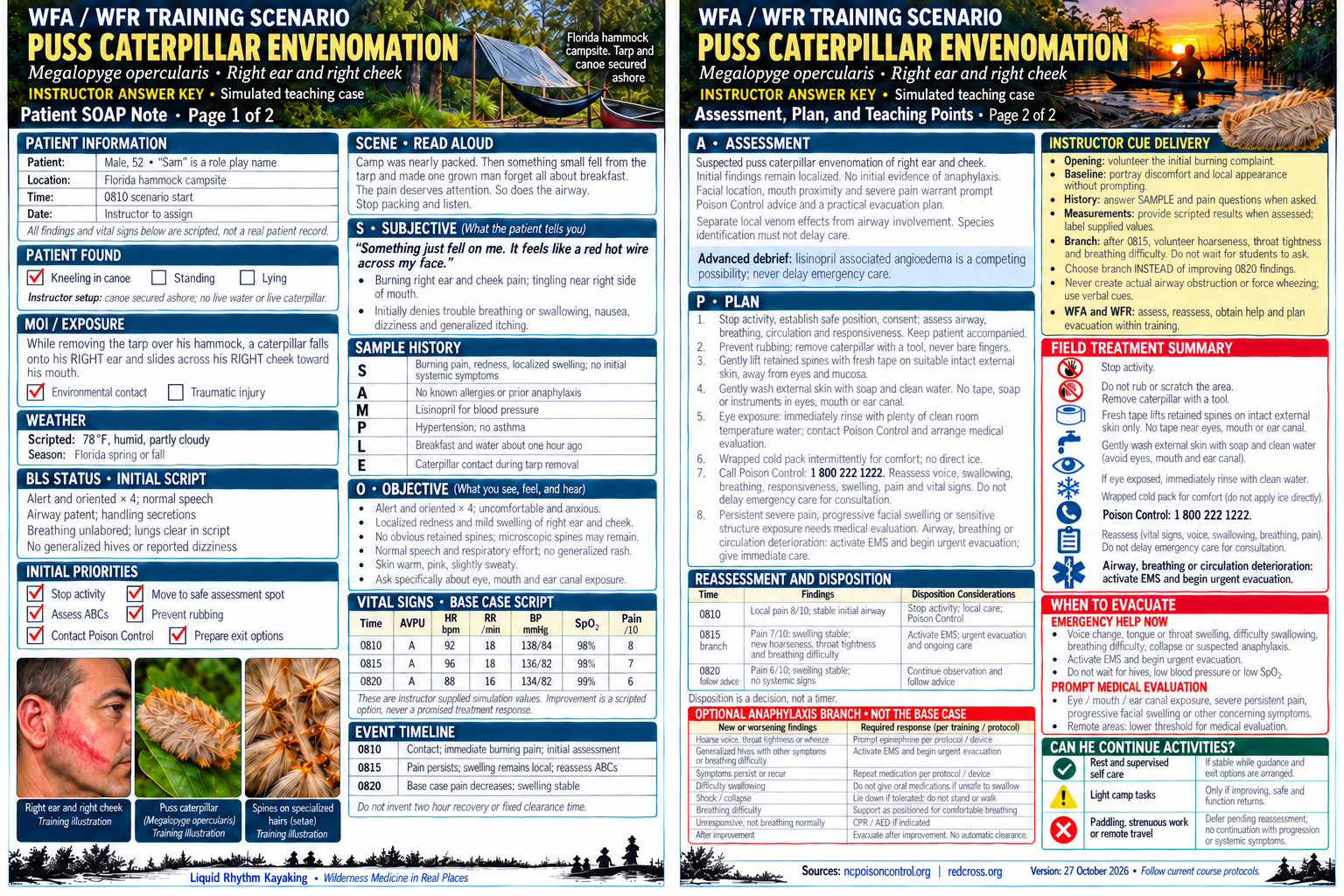
The art of making an injury worth noticing
There is an art to moulage, the application of mock injuries for training emergency response teams, medical personnel and wilderness first aid students. Believable makeup gives students something to notice, examine and document. More red does not necessarily mean more realism. Sometimes it only means you have used more red.
Keep this effect local and let the actor carry the pain. A guarded hand near the cheek and a clear description of burning can teach more than a spectacular appliance.
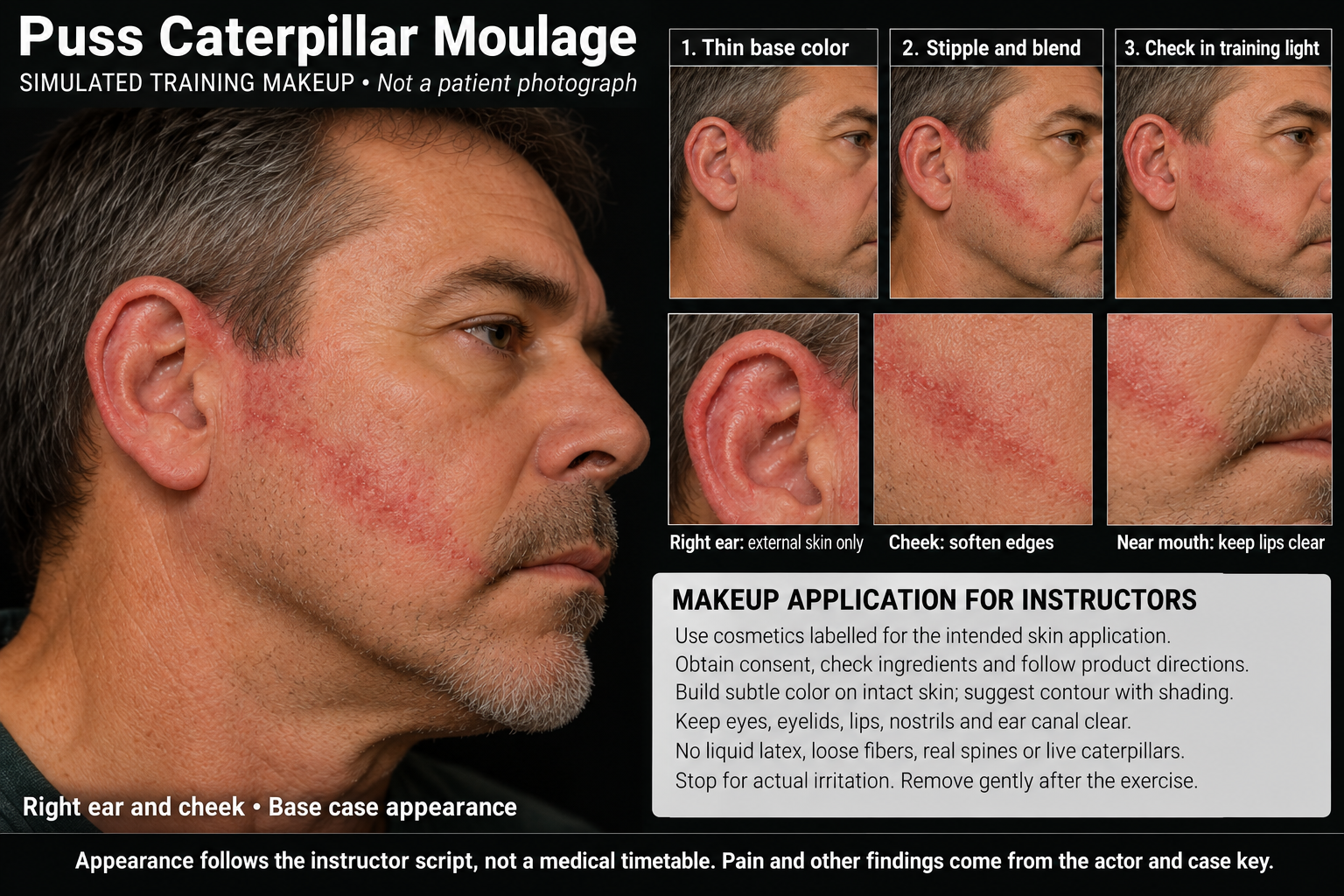
- Prepare the actor. Obtain consent, check ingredients and sensitivities, and follow product directions. Test unfamiliar cosmetics in advance as directed; this does not guarantee freedom from a reaction. Use clean tools and a separate palette. Stop for actual irritation.
- Build lightly. On intact external skin, stipple thin theatrical color along the right ear and cheek contact path. Blend irregular edges. Choose tones suited to the actor’s skin and check them in the training light.
- Suggest contour. Use restrained shading rather than liquid latex or raised appliances for this facial exercise. Supply warmth, swelling and tenderness through the case key and actor responses.
- Protect sensitive areas. Keep eyes, eyelids, lips, nostrils and ear canal clear. Use cosmetics labelled for the intended application. No loose fibers, real spines, caterpillar hairs or live animals.
- Match the script. The base case remains local and stable through 0820. Makeup supplies appearance; the actor and instructor supply other findings. Release anaphylaxis cues only in the separate branch.
- Rehearse safely. Ask before examination. Demonstrate tape removal on a separate suitable training surface, not repeatedly on the actor’s face. Use medication trainers only. Remove makeup gently, inspect the skin and clean equipment after the exercise.
The FDA’s novelty makeup guidance covers product checks and removal; its latex guidance explains ingredient risks.
Optional instructor branch: when the problem changes
Hypothetical deterioration, not the base case. After the 0815 assessment, choose this branch instead of the improving 0820 findings. Sam develops a hoarse voice, throat tightness and wheezing. You may add generalized hives and faintness as further instructor cues. Do not retain the improving vital signs as though both outcomes occurred.
Brief the actor on this branch before the exercise; release the new cues at the chosen time and let students recognize the change. Suspected anaphylaxis requires prompt epinephrine within training and applicable protocol, EMS activation and urgent evacuation. American Red Cross anaphylaxis guidance describes emergency recognition and epinephrine care.
- Support airway, breathing and circulation. Do not wait for hives, a low blood pressure or a falling oxygen reading.
- Record medication, dose, route, administration time and response. If symptoms persist or recur, repeat epinephrine according to your protocol and the device instructions.
- If shock develops, have Sam lie down if tolerated. Do not let him stand or walk. If breathing is difficult, support a position that eases breathing.
- Give nothing by mouth if swallowing is unsafe. Antihistamines do not replace epinephrine.
- If unresponsive and not breathing normally, begin CPR and use an AED according to training.
- Continue emergency evacuation even if symptoms improve.
Use a trainer device in class. Tell the actor which symptoms to portray and when. Do not ask anyone to produce real wheezing, breath holding or airway obstruction.
Performance criteria: what competent care looks like
Mark each item demonstrated, prompted or missed. Debrief the action and the reason behind it; this checklist supports the exercise and does not replace course certification standards.
- Establishes scene safety, obtains consent and assesses responsiveness, airway, breathing and circulation before becoming absorbed in the red patch.
- Obtains SAMPLE and pain history, including medication use; asks about voice, swallowing, breathing and possible eye or mouth exposure.
- Describes local findings without treating appearance alone as proof of anaphylaxis or ruling it out because hives are absent.
- Explains gentle external skin care, avoids rubbing and contamination, and describes immediate eye rinsing if that exposure is introduced.
- Repeats and records the assessment, distinguishes measured findings from instructor supplied values, and identifies meaningful changes.
- Practices a Poison Control consultation and gives a usable location, access and evacuation plan while keeping the patient accompanied.
- In the optional branch, recognizes deterioration, gives or assists with epinephrine according to training and protocol, activates EMS and begins urgent evacuation without waiting for another vital sign set.
Advanced instructor debrief: Lisinopril raises medication associated angioedema as a competing possibility if tongue or throat swelling develops. It is not established in this case. Discuss it after the response; differential assessment must not delay airway care or epinephrine when anaphylaxis is suspected.
What I want the students to notice
Both WFA and WFR students need a relevant medication history, repeated assessment, appropriate care, documentation and an evacuation plan. For WFR students, deepen the discussion of trends, differential assessment and transport decisions within the course curriculum.
- What did you assess before examining the red area?
- Which findings support a local reaction at 0810?
- What would make you act before taking another set of vital signs?
- How would eye or mouth exposure change your consultation and evacuation plan?
- Who is caring for Sam while someone else calls for help?
- What makes the planned route unsuitable for an impaired patient?
Continue the SOAP series
- The Sting That Wouldn’t Stop: another local venom reaction with a separate anaphylaxis discussion.
- The Bite He Ignored: delayed reporting and a worsening wound.
- Florida Summer Hypothermia: assessment beyond the obvious explanation.
- Multiple Trauma, Distraction Injury, and Chest Wall Emergency: finding the threat behind the distraction.
- Murphy’s Worst Day on the Trail: closed injuries and changing evacuation urgency.
Instructor use: Follow your current course curriculum and medical protocols. Clinical sources are linked beside the guidance they support.

