
The headwind that changed my paddle
On my first expedition with Sean and Todd, we paddled around Pinellas County. On the last day, we left our island camp at Cooper’s Bayou and headed north up Old Tampa Bay toward the State Road 580 bridge at Oldsmar. We had a lot of headwind.
I swapped my carbon-fiber Lendal Nordkapp for my cedar Greenland paddle. The difference felt immediate. I no longer felt the wind grabbing the blade exposed above the water. My rotation improved, and the sound of the wooden blade entering the water disappeared.
Then Sean and Todd noticed I was overtaking them. I was moving faster, with what looked like very little effort. I could feel the difference too. That experience stayed with me.
It was a change I felt on that stretch of water, not a controlled comparison of paddle designs. But it is a good example of why I look at the water, the boat, the conditions, and where I expect to put the blade before choosing a paddle. I alternate between a wooden Greenland paddle, a Euro-blade paddle, and a single-bladed canoe paddle. I also have a wing paddle that is perfect when I am paddling my surfski.
When I reach for my wooden Greenland paddle
If I am enjoying a day in deeper water with high winds, I often reach for my Tuktu Greenland paddle. I enjoy the beauty of a wooden paddle, but the feel matters just as much. In the Florida summer, wood feels cool to my hands while my carbon-fiber paddle heats up in the sun. In winter, wood feels warmer to me than carbon. I have noticed the same contrast with my fiberglass paddle. Carbon Greenland paddles are nice to look at. I still prefer the feel of wood.
Fit matters. The loom, where the blade begins, and the dimensions of the paddle all affect how comfortably I can hold and use it. A custom wooden paddle can be shaped around the paddler, but custom work is not the only way to get a suitable Greenland paddle.
Commercial Greenland paddles are available through manufacturers and retailers. Gearlab’s Kalleq is one current carbon example. That is an example of availability, not a claim that it is the right paddle for everyone. My preference for wood does not make carbon a poor choice for somebody else.
Warm wood, wet hands
The winter problem is that my hands are always wet. I use kayak mitts or pogies, including ones like those made by Kokatat, Heytur, or Xuker. Their openings may need altering to accommodate the loom and blade-root area of a Greenland paddle.
I am good with a sewing machine, so I alter the opening to suit my paddle. The fit has to let me get my hands out freely. Keeping my hands comfortable matters; trapping them in the mitts would defeat the point.
When I choose a Euro-blade paddle
If I expect shallow water for much of the day, I often choose my carbon-fiber Lendal Nordkapp Euro-blade paddle. That is how I have used the equipment I own; it does not mean a Greenland paddle cannot be used in shallow water. Blade shape, stroke angle, water depth, and the room available for the stroke all matter.
Fixed-length paddles are not the only option, and paddlers do not have to accept a poor fit between catalog sizes. Adjustable-length touring paddles are available. I would rather help a student assess fit in the boat than assume a length will work because it is commonly sold.
Why a canoe paddle comes into the mangroves
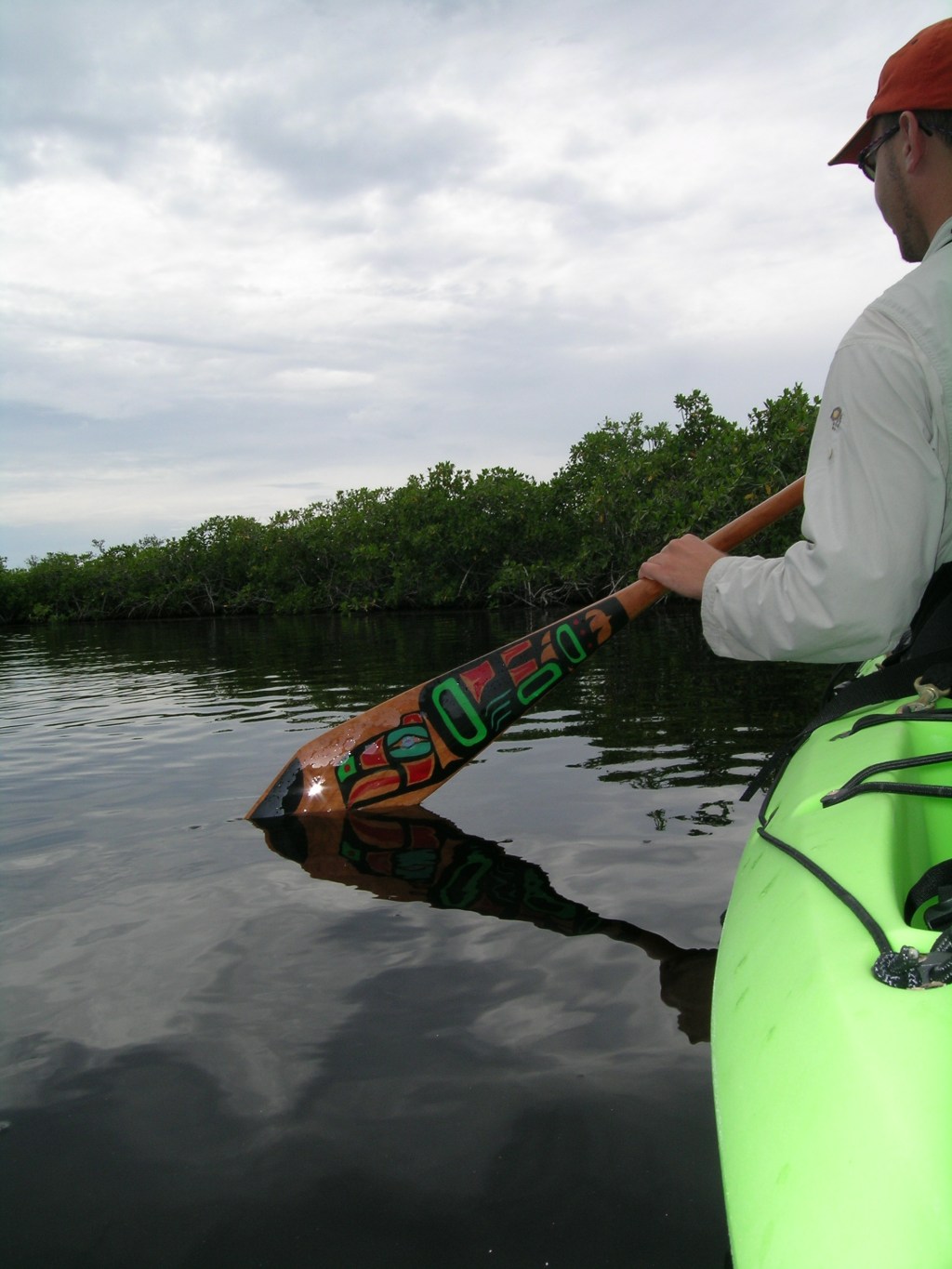
Around seagrass and in tight mangrove tunnels, I sometimes choose a Tlingit-style canoe paddle. The one I use most is cherry wood, with a beautiful hand-painted raven on the blade. Its diamond-shaped blade enters the water smoothly. In my experience, it slips between the grass blades without the tangling I have encountered with broader kayak blades. When grass catches around a paddle, continuing to pull can uproot it. Avoiding that catch is part of why I choose this shape.
The first thing a student usually asks is, “Aren’t you afraid of scratching it?” Then they pick it up and are surprised by the weight. The cherry paddle is heavier than they expect, but its buoyancy helps support it in the water. Holding it ashore and paddling with it are different experiences.
I am describing how this particular paddle has worked for me, not saying that every Euro-blade paddle tangles in grass or that a diamond-shaped blade cannot cause damage. The goal is to move the boat without digging into the bottom or pulling through vegetation.
The single blade also gives me room to maneuver where a double-bladed paddle becomes awkward. In a restrictive mangrove tunnel, that can matter more to me than which paddle I prefer out in the open.
I have also used cedar. It has a little give if I accidentally bump a mangrove root or limb. So far, I have not caused any gouging or scraping with that wooden paddle. I still try to keep the blade clear of roots and branches; wood is not a guarantee against damage.
Sometimes the choice starts with the paddler
In the summer of 2006, I taught a kayaking class at the Extremity Games in Orlando, Florida. One of my students found my Tlingit-style canoe paddle particularly comfortable to use. Her residual limb fit its Y-shaped grip, giving her a useful point of contact while her other hand held the shaft.
I had chosen that paddle for its handling in Florida’s shallow water and mangrove tunnels. During that class, its grip offered an advantage I had not chosen it for.
That is part of teaching: pay attention to what works for the person in the boat. In her case, the paddle’s existing shape provided a good fit. Another paddler might need a different grip or arrangement. The useful choice begins with the student.
A short word about Greenland grip and feel
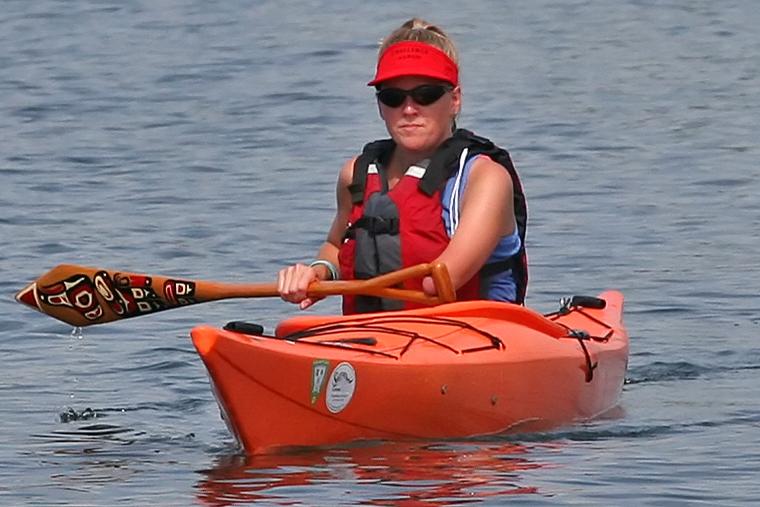
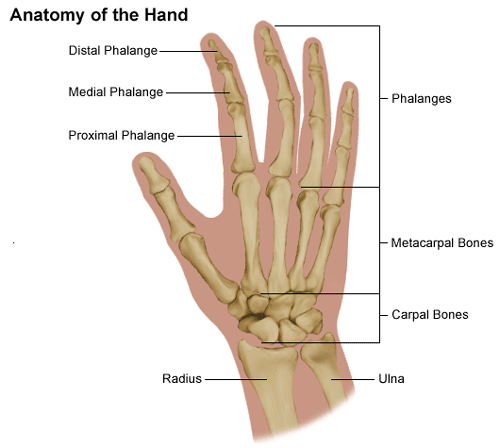
In Greenland Technique: Strokes at Qajaq USA, Greg Stamer describes a common grip with the thumb and index finger of each hand around the loom—the shaft between the blades—and the remaining fingers resting over the blade roots.
With a suitable paddle and a relaxed wrist, that grip can allow a natural forward cant. For this technique, the upper blade edge is slightly closer to the bow than the lower edge. The amount varies with the paddler and paddle; it is not an angle to force with the wrists.
I have also experienced the forward thrust Greg Stamer describes during the upward movement of a canted Greenland blade in a particular stroke variation. His Forward Stroke with Greenland Paddle? explains that movement in the context of the crunch stroke. My earlier “turbo boost” description was shorthand for a sensation I recognize, not a reason to scoop water at the end of every stroke.
That deserves a separate illustrated technique article. This article is about choosing a paddle and understanding why I switch, rather than trying to teach an entire forward stroke in a few paragraphs.
Choose for the place you are paddling
None of my paddles disappoints me. Each has a purpose and an environment where it excels. A golfer takes several clubs to play 18 holes. I feel much the same about a kayaker going any distance: carry more than one paddle so you have a choice when the water and conditions change.
For related reading, explore my Greenland kayaking resources and Tuiliks in Florida? For current instruction and appointments, visit kayaking classes and pricing.


Leave a Reply