
Some of the most important lessons in kayaking begin long before a customer purchases a boat. They begin when an instructor takes that same boat onto the water and discovers what it can actually do.
The Best Classroom Had No Walls
There is a difference between knowing the specifications of a kayak and knowing what happens when a wave catches its stern. A brochure can describe dimensions and intended uses. It cannot replace firsthand experience.
In September 2006, following Hurricane Ernesto, three of us traveled to Florida’s Atlantic coast near Jacksonville with several Ocean Kayaks. We wanted to become better at helping people choose kayaks, and we intended to accomplish that by getting wet.
Our equipment included an Ocean Kayak Yak Board and Prowler 13, two sit on top designs with considerably different priorities. We traveled between the Mayport Poles and Jacksonville Beach Pier looking for suitable surf. I no longer remember precisely where we launched, and I would rather acknowledge that uncertainty than invent a detail.
Customers entering our shop often dreamed of fishing, coastal exploration, family outings, or surf. They were purchasing the possibility of adventure. Our responsibility was to understand the difference between what a kayak could do and what an inexperienced paddler could safely do with it.
The Ocean Kayak Yak Board: A Little Boat with a Big Personality
The original Yak Board was short, uncomplicated, and maneuverable. For a beginner, the first achievement in kayak surfing is often catching a wave and riding straight toward shore. The wave lifts the stern, the boat accelerates, and the paddler discovers the exhilaration of moving water.
But there is another level. An experienced paddler can turn and ride laterally across the unbroken face of a wave. Doing so requires wave reading, positioning, boat angle, and continuous adjustments to speed and pressure.
During our training I could make those lateral rides on the Yak Board. The other paddlers were primarily catching waves and riding toward shore. There was nothing wrong with that. They were learning, and that was why we had come.
What the Yak Board Taught Us
The short hull encouraged quick directional changes. The sit on top configuration made remounting relatively straightforward. Its simple layout helped paddlers focus on boat handling. But none of these features replaced technique, wave selection, bracing, or sound judgment. The boat provides possibilities; the paddler develops the ability to use them.
The Prowler 13: Possible Is Not the Same as Practical
The Ocean Kayak Prowler 13 represented another side of the sport. Its longer, fishing oriented layout prioritized different uses from the Yak Board. A capable paddler can negotiate surf in many kayaks, but that does not make every kayak a dedicated surf boat.
Length, hull form, outfitting, and weight distribution influence how a kayak responds. A longer hull can require more effort to redirect. Fishing equipment introduces additional hazards if not secured. A kayak that performs well in sheltered fishing waters may demand substantially more skill during a surf launch or landing.
A kayak’s ability to survive an activity is not the same as its suitability for that activity. Understanding that difference was part of our responsibility to customers.
Historical Equipment Comparison
These are general design observations, not measurements collected during controlled testing in 2006.
Yak Board: compact recreational surf play design; quick directional response; relatively simple outfitting; less emphasis on straight line tracking.
Prowler 13: longer recreational fishing design; greater emphasis on tracking and carrying fishing gear; more deliberate directional response; not primarily a surf play kayak.
Exact specifications, production years, and model variations should be checked against original Ocean Kayak catalogs before being presented as definitive historical facts.
A Good Instructor Remembers Being a Beginner
Experience can make skills instinctive. You recognize a forming wave, sense a developing broach, and anticipate the stern’s movement. A newcomer does not yet have those experiences. Instruction cannot begin with everything the instructor knows. It must begin with what the student understands.
Watching the others reminded me to break complex maneuvers into teachable steps. Understanding how the boats behaved with paddlers of different abilities would make us better instructors and better at recommending equipment.
What Surf Teaches About Control and Safety
Surf exposes weaknesses in technique quickly. Once a wave takes hold of the kayak, directional control matters as much as forward speed. Effective paddle placement, edging, bracing, and recovery become essential.
A capsize in breaking surf involves moving water, a potentially tumbling kayak, and risks of collision with the bottom or another paddler. Responsible instruction includes launch and landing choices, separation, and a willingness to stop when conditions exceed the group’s abilities.
Hurricane Ernesto had passed, but the passage of a tropical system does not automatically make the ocean safe. Groundswell, rip currents, shifting sandbars, and shorebreak may remain. Evaluate the conditions actually present, not merely the storm’s position. Sometimes the right decision is to leave the kayaks on the vehicle.
Historical Field Notes: September 2006
Date: September 2006, after Hurricane Ernesto (August 24 through September 1, 2006). General location: Atlantic coast near Jacksonville, Florida. Areas explored: Mayport Poles and Jacksonville Beach Pier. Exact launch site: not independently established.
Equipment: Ocean Kayak Yak Board and Prowler 13. Participants: three paddlers. Purpose: firsthand equipment familiarization and surf training to improve instruction and customer advice.
Firsthand recollection: I demonstrated lateral rides across unbroken wave faces in the Yak Board while the other participants were primarily learning to catch waves and ride toward shore.
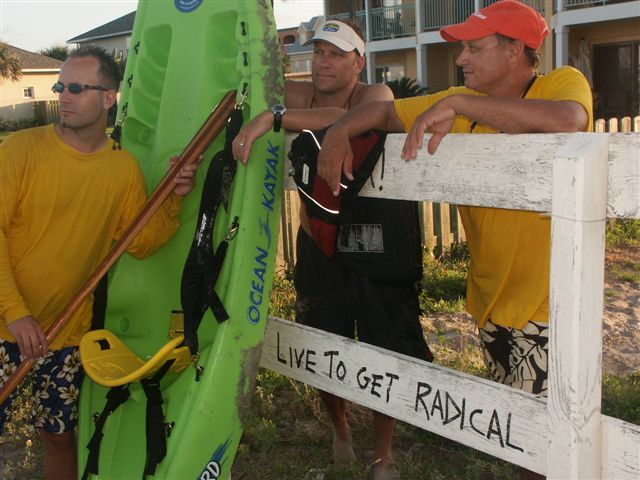
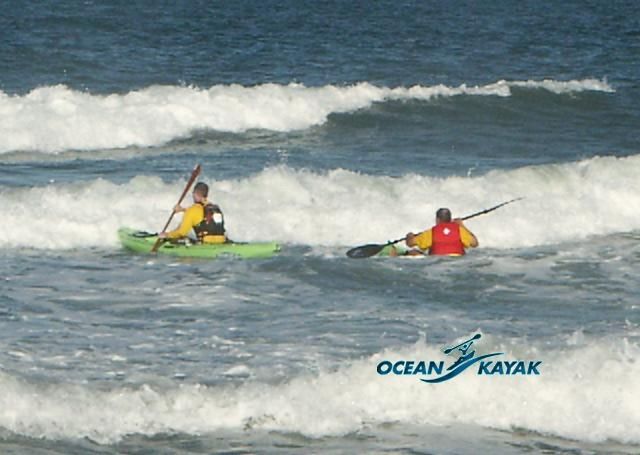
Photographic record: one surviving photograph shows three paddlers beside a green Ocean Kayak and a wooden LIVE TO GET RADICAL sign. Another shows paddlers approaching breaking surf. These images do not independently establish the exact launch site, wave height, performance measurements, or full sequence of activities.
The Photograph That Outlasted the Kayaks
Somebody photographed the three of us beside a green Ocean Kayak and a weathered sign: LIVE TO GET RADICAL. It suited the moment, and it still makes me smile. But twenty years later I see something more important than a carefree day in the surf. We were developing knowledge that could be passed on.
The boats have become part of paddling history. The techniques remain relevant. The responsibility to teach people how to use equipment safely has not changed.
Should You Buy an Original Yak Board or Prowler 13 Today?
Both models are worth considering for paddlers interested in older recreational designs, provided the boat is sound and suits the intended use. The Yak Board may appeal to recreational surf paddlers; the Prowler 13 to those seeking a traditional fishing kayak.
Inspect aging polyethylene carefully for ultraviolet damage, brittleness, cracks, deformation, and repairs. Pay attention to scuppers, fittings, molded handles, and stress points. Check that components are secure and replacement parts can be sourced. A low price does not make a damaged hull a bargain.
I would enjoy seeing more of these old Ocean Kayaks return to the water. But condition, intended use, and paddler ability matter more than nostalgia.
Twenty Years Later, the Lesson Hasn’t Changed
On October 8, 2026, Florida is once again paying attention to hurricane season. These photographs remind me that decisions made before launching matter as much as skills demonstrated on the water.
Where should we launch? What are the conditions doing? What happens if someone capsizes? Can everyone in the group manage the environment? And are we choosing this adventure because conditions are suitable, or because we already decided we wanted to go?
The best paddlers I have known were not necessarily the people willing to take the greatest risks. They were the people who understood those risks well enough to make good decisions.
Twenty years ago we traveled to Jacksonville to become better at selling kayaks. What we were really doing was becoming better students of the water. That education never ends.
Learn the boat. Read the water. Respect the conditions. And when everything comes together, get a little radical.
The Old Ways Still Work.
About the Author
Jeff Fabiszewski is an outdoor educator, expedition sea kayaker, and professional kayak instructor. A founding partner of Liquid Rhythm Kayaking, he has spent decades teaching paddling skills, expedition preparation, rescue techniques, and responsible outdoor leadership. His work emphasizes preserving practical paddlesports knowledge for future generations.

